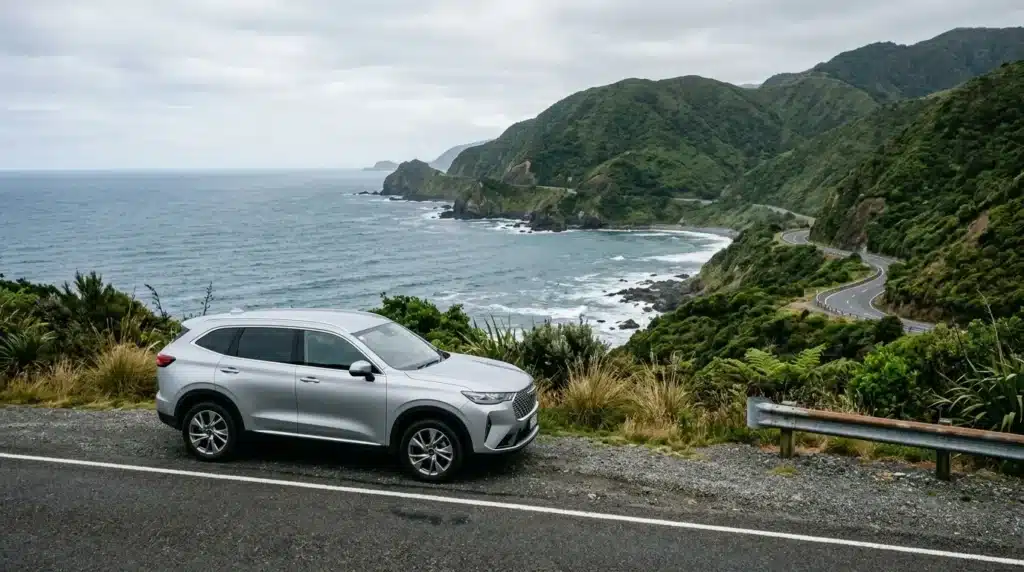
Five years ago, mentioning a Chinese SUV in a NZ dealership would have earned you a polite smile and a pivot toward the Toyota aisle. That’s changed. Walk into any Haval showroom today and you’ll find Kiwi buyers genuinely considering — and buying — GWM’s SUVs over household Japanese and Korean names.
I’ve been watching this shift closely. The question I get asked most often isn’t whether Haval SUVs look good or come loaded with features — they clearly do both. The real question is whether they hold together, whether parts are available when something goes wrong, and whether buying one in 2026 is a decision you’ll still feel good about in 2029.
In this article I’m going to give you my honest take on GWM Haval in NZ: what’s available, what they cost, how they actually perform on Kiwi roads, and who they’re genuinely right for.
GWM and Haval: Who Actually Makes These Cars?
GWM (Great Wall Motors) is China’s largest SUV and pickup manufacturer. Founded in 1984, they’ve been exporting globally since the mid-2000s and now sell in over 170 countries. Haval is their dedicated SUV brand — think of it the way Toyota has Lexus, except Haval sits at the mainstream rather than luxury end.
GWM entered NZ officially in 2021 and has grown steadily since. They’re not a pop-up operation or a brand trying to offload unsold stock. They have a dedicated importer, an expanding dealer network, and a clear long-term strategy in this market.
That matters because one of the biggest risks with emerging brands in NZ isn’t the car itself — it’s whether the company will still be here in five years to honour warranties and supply parts. With GWM, I’m reasonably confident they’re here to stay.
Haval Models Available in NZ in 2026
The local lineup has tightened up from the early days. Right now you’re realistically choosing between two core models:
| Model | Body Style | Engine | Drive | RRP (NZD) |
|—|—|—|—|—|
| Haval Jolion | Compact SUV | 1.5T Petrol (147kW) | FWD | $31,990 – $40,990 |
| Haval H6 | Mid-size SUV | 2.0T Petrol (165kW) | FWD / AWD | $38,990 – $47,990 |
| Haval H6 GT | Coupe SUV | 2.0T Petrol (165kW) | FWD / AWD | $41,990 – $49,990 |
The Jolion is the volume seller — a compact SUV that competes directly with the Kia Stonic and Hyundai Venue, but punches well above its price with a full-sized interior feel.
The H6 is where GWM puts its best foot forward. It’s a genuinely spacious mid-sizer competing against the Kia Sportage, Hyundai Tucson, and Toyota RAV4 — and it undercuts all three on price while matching or exceeding them on feature count.
The H6 GT is the coupe-roofline variant for buyers who want the H6’s practicality with a sportier silhouette. Boot space takes a small hit, but it looks the part.
Haval vs the Competition: Key Specs at a Glance
Prices are approximate NZD RRP as of April 2026. Value score reflects features-per-dollar for the NZ market.
How Haval SUVs Actually Drive on NZ Roads
The Jolion’s 1.5-litre turbo is surprisingly punchy for daily use. It pulls confidently from 50–100km/h, which is where most NZ driving happens — filtering onto motorways, passing on open roads. I’ve found the 7-speed dual-clutch gearbox smooth at highway speeds but occasionally hesitant in slow traffic. It’s not a deal-breaker, but it’s noticeable.
The H6’s 2.0-litre turbo is a step up in refinement. Power delivery is linear, the engine is quiet under normal loads, and the AWD system earns its keep on gravel driveways and wet roads. This is a car that feels settled and planted — qualities that matter when you’re on a winding Coromandel road in the wet.
Ride quality across both models leans toward comfort. Potholes and chip seal don’t upset them the way stiffer European SUVs can. For NZ’s variable road surfaces, that’s a genuine advantage.
The one honest criticism: steering feel is light and somewhat numb compared to a Mazda CX-5 or a Kia Sportage. It’s not unsafe — it just doesn’t communicate much through your hands. For city and motorway driving, most people won’t care. If you’re someone who enjoys driving for its own sake, you’ll notice it.
Reliability and Ownership Costs: The Real Kiwi Concern
This is where the honest conversation gets more complicated.
The warranty is genuinely good — 5 years/100,000km bumper-to-bumper. That matches most Japanese and Korean competitors and gives you solid coverage for the first ownership cycle.
Service intervals are set at 10,000km, which is reasonable. GWM has authorised service centres in Auckland, Wellington, Christchurch, and several regional centres. The network is thinner than Toyota or Hyundai — if you’re in a smaller town, you may need to travel for servicing.
Spare parts is the area I watch most closely. As of 2026, common wear items (filters, brakes, tyres) are readily available. Crash repair panels and mechanical components have improved significantly, but they’re not yet at the level where any panel beater or mechanic can source them overnight. If this worries you, I’d strongly recommend checking with your nearest dealer before buying.
Long-term reliability data for these models in NZ is still limited — simply because the cars haven’t been here long enough in volume. Anecdotal owner feedback is mostly positive for the first 50,000–80,000km, but I’m not yet confident recommending them for buyers who plan to run a car to 200,000km without detailed knowledge of what breaks and when.
Safety: What the ANCAP Ratings Tell You
Safety is one area where Haval has done the right thing — they’ve submitted their cars for independent testing rather than relying on self-reported figures.
- Haval Jolion: 5-star ANCAP rating (2021, under ANCAP 2020 protocols)
- Haval H6: 5-star ANCAP rating (2022)
Both cars come standard with autonomous emergency braking (AEB), lane-keeping assist, blind-spot monitoring, and rear cross-traffic alert across all grades. You don’t have to pay for a premium variant to get meaningful safety tech — it’s standard from entry level.
For NZ’s high rural road toll and the mix of motorway and open-road driving most Kiwis do, these ratings matter. I wouldn’t recommend a car without at least 5-star ANCAP, and Haval clears that bar.
5-Year Running Cost Estimator: Haval H6 vs RAV4 vs Sportage
5-Year Ownership Cost Estimator (NZD)
The calculator above highlights the core trade-off clearly. The Haval H6 is cheaper to buy and cheaper to run day-to-day — but its estimated depreciation rate is significantly higher than the RAV4’s. Toyota’s resale strength is real and well-documented in NZ. If you plan to sell within 3–5 years, that depreciation gap narrows your savings considerably.
Who Should Buy a Haval — and Who Shouldn’t
A Haval makes strong sense if:
- You’re buying as a long-hold vehicle (7+ years) and aren’t concerned about resale
- You’re comparing feature-for-feature and want the most car for your budget
- You live in a main centre with access to a GWM dealer for servicing
- You want a spacious, comfortable family SUV without stretching into the $55k+ bracket
I’d steer you elsewhere if:
- You’re in a rural area more than 100km from a GWM service centre
- You plan to sell in 2–3 years and resale value matters to your budget planning
- You need parts and service available anywhere in NZ without pre-planning
- You want a car with a proven high-mileage reliability record beyond 150,000km in Kiwi conditions
The honest truth is that Haval has earned its place in the NZ market on value and features. What it hasn’t yet earned is the same unconditional trust Kiwis extend to Toyota, Mazda, or Hyundai — and that trust only comes from years of data and widespread ownership experience. We’re getting there, but we’re not there yet.
For the right buyer, the Haval H6 in particular is genuinely one of the best-value mid-size SUVs you can buy in NZ right now. I’d recommend a test drive without hesitation — just go in with clear eyes about the trade-offs.
Feel free to drop any questions about specific Haval models in the comments below. I’m happy to help you work through whether one’s right for your situation.