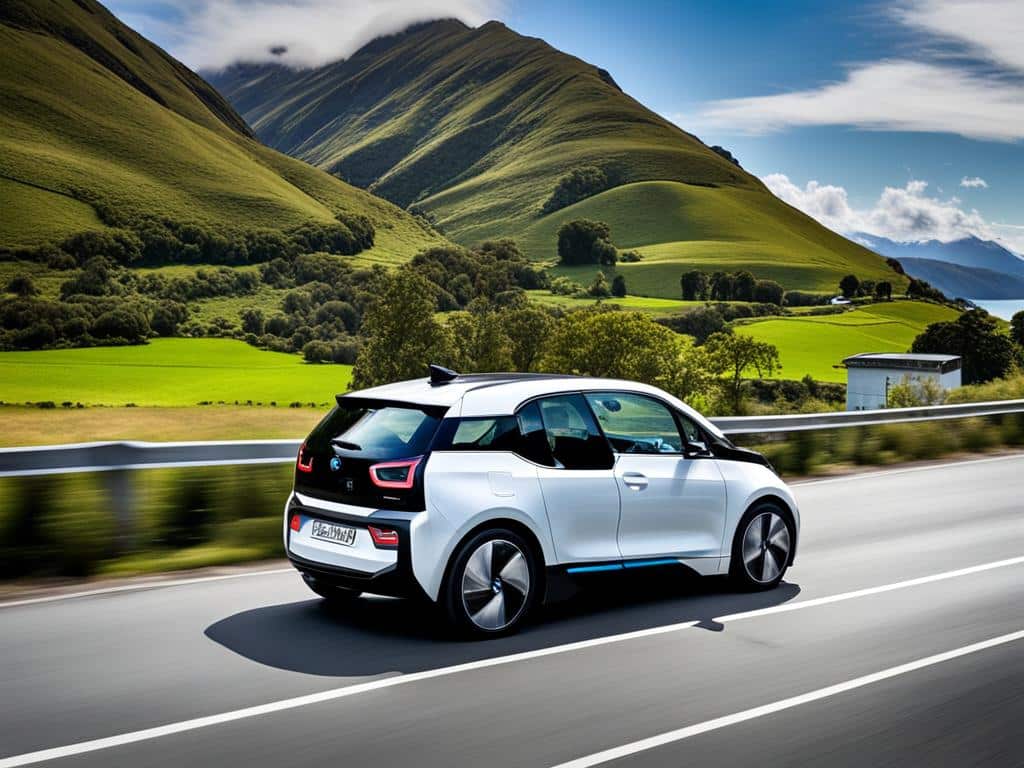
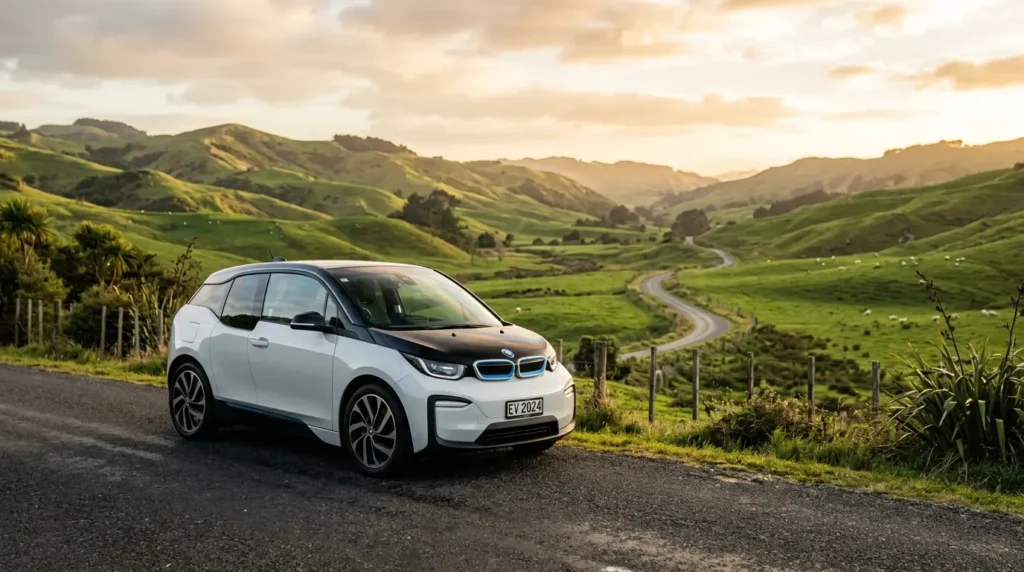
The BMW i3 is one of the most polarising cars ever to hit the used market in New Zealand. Some buyers love it for its low running costs and quirky character. Others walk away confused by the rear-hinged doors, small boot, and cabin made from recycled fishing nets.
I’ve spent time with multiple i3s across different battery generations, and my honest take is this: for the right buyer, at the right price, the i3 is one of the smartest used EV purchases you can make in NZ right now. But it’s not for everyone, and the battery generation you choose matters enormously.
This review covers everything a NZ buyer needs to know — range, pricing, reliability, running costs, and how it compares to the Nissan Leaf and BYD Dolphin on the used market.
Which BMW i3 Battery Should You Buy in NZ?
BMW built three distinct battery generations over the i3’s production run (2013–2021). The version you buy has a bigger impact on your daily experience than any other single factor.
| Generation | Battery | Net Range (WLTP) | NZ Used Price (2026) |
|—|—|—|—|
| 60Ah (2013–2016) | 22 kWh | ~120–130 km | $10,000–$16,000 |
| 94Ah (2016–2018) | 33 kWh | ~170–195 km | $16,000–$24,000 |
| 120Ah (2018–2021) | 42.2 kWh | ~230–260 km | $22,000–$35,000 |
My recommendation: avoid the 60Ah unless the price is exceptional. 120 km of real-world range is workable for inner-city driving but leaves almost no buffer on a cold Wellington day or a trip up the Kapiti Coast. The 94Ah is the sweet spot for value. The 120Ah is the one to buy if you want a car you’ll keep for five-plus years.
Note that many NZ i3s are Japanese imports — right-hand drive was standard from the factory, which is ideal for us.
BMW i3 NZ Pricing: What Does It Cost to Buy in 2026?
The used i3 market in NZ has matured significantly. Prices have softened compared to 2022–2023, which makes now a reasonable time to buy if you’ve been watching and waiting.
For a clean, low-kilometre 120Ah i3 with a full service history, expect to pay $28,000–$35,000. For a well-maintained 94Ah with under 60,000 km, budget $18,000–$24,000. The older 60Ah models regularly appear under $14,000.
A few things that affect price significantly:
- i3s variant — BMW’s sportier version with 135 kW motor; commands a ~$2,000–$4,000 premium
- REx (range extender) — the two-cylinder petrol backup tank adds range but also maintenance complexity; prices vary, but I’d only consider it if your regular driving genuinely exceeds 200 km
- Service history — BMW dealer servicing records add real value on these cars
- Carbon fibre body panels — some light crash damage is expensive to repair; always get a LIN check before buying
Check the vehicle ownership history via NZTA’s plate search before committing to any used i3. Flood or hail damage is common on Japanese imports.
BMW i3 Range in NZ: Real-World Numbers
The WLTP figures above are best-case. In New Zealand conditions, here’s what you’ll actually get:
120Ah i3:
- Summer (Auckland): 210–240 km
- Winter (Christchurch, cold mornings): 165–190 km
- Motorway at 100 km/h: 160–180 km
94Ah i3:
- Summer (Auckland): 155–175 km
- Winter (Christchurch): 120–145 km
- Motorway at 100 km/h: 125–145 km
The i3’s range drops more noticeably on motorways than city roads because the car was optimised for urban use. At 90 km/h instead of 100 km/h, you recover 15–20 km of range — worth knowing if you’re heading to Hamilton for the weekend.
AC charging on the i3 is 7.4 kW (single phase), so a full charge from flat takes around 6 hours on a 7 kW home wallbox. DC fast charging tops out at 50 kW, meaning 80% in about 40–45 minutes on a fast charger. There are now enough public CCS chargers on the main NZ corridors to make this practical.
BMW i3 Running Costs in NZ: How Much Will You Spend?
This is where the i3 genuinely shines. Despite being a premium European car, the day-to-day cost of ownership is low.
Electricity cost: At NZ’s average residential rate of ~$0.30/kWh, the 120Ah i3 costs roughly $3.90–$4.50 per 100 km to charge at home. Off-peak charging (overnight on a time-of-use plan) can cut this to under $3.00/100 km.
RUC: Since April 2024, light EVs in NZ pay Road User Charges at $76 per 1,000 km. That adds about $7.60 per 100 km — the biggest change to EV running costs in recent years. Budget for it.
Servicing: BMW i3 servicing is simpler than a petrol car — no oil changes, no timing belt. Expect to pay $300–$500 per year for a standard annual service at a BMW dealer or independent EV specialist. Brake pad wear is minimal thanks to regenerative braking; most owners replace pads every 80,000–100,000 km.
Battery health: The i3’s battery degrades slowly. A well-maintained 120Ah with 60,000 km typically retains 85–90% of its original capacity. Ask for a battery health report (via BMW diagnostics or a third-party OBD tool) before purchasing any used example.
BMW i3 Annual Running Cost Estimator (NZ)
Electricity cost based on home charging. RUC rate: $76/1,000 km (NZ, from April 2024). Petrol comparison assumes 9L/100km @ $2.50/L.
BMW i3 Reliability: What Actually Goes Wrong?
The i3 has a better reliability record than most people expect from a BMW. The drivetrain itself — motor, inverter, and battery — is largely trouble-free. The issues that do arise tend to be in the conventional parts of the car.
Common problems to watch for in NZ:
- Charging port contact corrosion — especially on earlier 60Ah and 94Ah models. Check that DC charging works reliably before buying.
- 12V auxiliary battery — the small 12V battery (separate from the traction battery) fails every 4–6 years. A flat 12V will leave you stranded even with a full main battery. Budget $200–$300 to replace it proactively.
- Rear door hinge wear — the suicide/coach doors are a distinctive design feature but the hinges can loosen on high-kilometre examples. Test both rear doors carefully.
- Plastic trim brittleness — the i3’s interior uses a lot of recycled and natural-fibre trim. Some of it becomes brittle with age and UV exposure. Inspect the dashboard carefully on older cars.
- Software and infotainment — the older i-Drive systems can be slow. CarPlay is available via aftermarket adapters.
The range extender (REx) requires more attention: the tiny two-cylinder petrol engine needs its own servicing (oil, spark plugs, air filter), and failure to maintain it can result in costly repairs. Check the REx service history carefully.
How Does the BMW i3 Compare to Other Used EVs in NZ?
Used EV Comparison: BMW i3 vs Nissan Leaf vs BYD Dolphin (NZ 2026)
Note: CHAdeMO (Nissan Leaf) chargers are less common in NZ than CCS (BMW i3, BYD Dolphin). Factor this into your decision.
The i3 is the smallest and least practical of the three, but it has the best driving feel. If you’re choosing between a 120Ah i3 and a 40 kWh Leaf at similar prices, the i3 wins on build quality and driving dynamics. If cargo space and range are your priorities, the Dolphin is the better call.
One thing worth flagging: the Nissan Leaf uses CHAdeMO for DC charging, which is becoming less common in NZ. The i3’s CCS port has much wider support at public chargers going forward.
Is the BMW i3 Right for You in NZ?
Buy the i3 if:
- You primarily drive in the city or do a daily commute under 80 km
- You can charge at home overnight
- You want premium build quality and a genuinely fun-to-drive city car
- You’re buying the 94Ah or 120Ah variant — not the 60Ah
Skip the i3 if:
- You regularly drive intercity (Wellington to Palmerston North, Auckland to Hamilton)
- You need to carry bulky items or more than 2 adults comfortably in the rear
- You want a car that’s straightforward to service anywhere in NZ — European EV specialists are concentrated in main centres
- You’re looking at a 60Ah under $13,000 as a daily driver — battery anxiety is real at those range numbers
My recommendation for 2026: The 94Ah i3 at $18,000–$22,000 is the best value entry point. You get enough real-world range for most NZ urban commuters, the running costs are genuinely low, and the driving experience is unlike any other car at that price point. Just budget $300 for a 12V battery swap on arrival and get a battery health report before you sign anything.