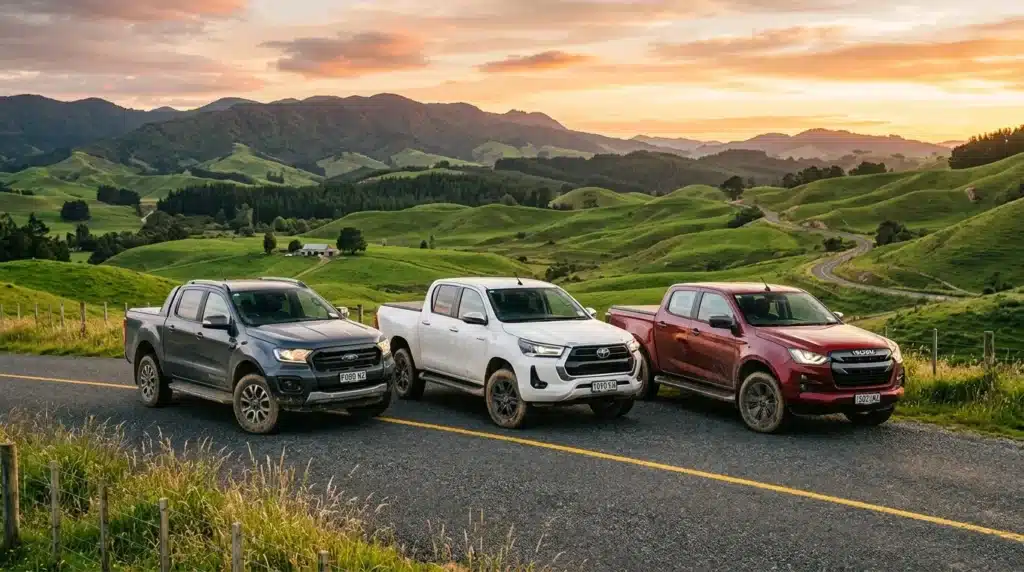
If you’re buying a vehicle in New Zealand right now, there’s a good chance a ute is on the shortlist. The Ford Ranger has been NZ’s best-selling vehicle for several years running, and the Toyota Hilux isn’t far behind. Together they account for a huge chunk of all new vehicle registrations in this country.
But the market in 2026 looks different from even two years ago. Prices have climbed significantly. Diesel RUC costs are a real ongoing expense. And newer competitors — particularly the Isuzu D-Max — are giving buyers genuine alternatives worth considering.
I’ve been following the NZ ute market closely, and I think a lot of buyers are still defaulting to Ranger or Hilux out of habit rather than making an informed comparison. This guide gives you an honest breakdown of what each ute actually costs to buy, run, and live with on NZ roads.
Why Utes Dominate NZ’s Best-Seller Lists Year After Year
There’s a reason pickup trucks are everywhere on NZ roads — and it’s not just tradies. Utes in New Zealand fill a role that no other vehicle type does as well.
They carry gear. They tow boats, horse floats, and trailers. They handle the rough tracks that sedans and crossovers can’t. And increasingly, they double as the family’s only vehicle — dropping the kids off at school on Monday and hauling gravel on Saturday.
The tax treatment for business use has historically made utes attractive for self-employed buyers, though the rules around private use have tightened. If that applies to you, check with your accountant before factoring this into your decision.
The honest downside: utes are no longer the budget option. A fully-loaded Ranger Wildtrak or Hilux SR5 sits well above $65,000. Running costs — especially RUC on top of fuel — add several thousand dollars per year that many buyers underestimate when comparing at the dealership.
2026 NZ Ute Specs and Pricing at a Glance
Before diving into each model, here’s where the main contenders sit on key specs. All pricing is indicative NZD including GST for 4×4 double cab variants.
| Model | Engine | Max Payload | Max Tow | Base 4×4 Price | Top Spec Price |
|---|---|---|---|---|---|
| Ford Ranger XLT | 2.0L Bi-Turbo Diesel | 1,012 kg | 3,500 kg | $59,990 | $89,990 (Raptor) |
| Toyota Hilux SR | 2.8L Turbo Diesel | 1,045 kg | 3,500 kg | $58,990 | $78,990 (GR Sport) |
| Isuzu D-Max SX | 3.0L Turbo Diesel | 1,045 kg | 3,500 kg | $52,990 | $71,990 (X-Terrain) |
| Mitsubishi Triton GSR | 2.4L Diesel | 905 kg | 3,100 kg | $54,990 | $62,990 |
| Nissan Navara Pro-4X | 2.3L Bi-Turbo | 936 kg | 3,500 kg | $55,990 | N/A |
The D-Max leads on price by a meaningful margin. The Hilux and D-Max tie on payload. The Triton and Navara are worth considering if budget is your primary driver, but I’ll focus on the top three here since they represent the best overall packages for most NZ buyers.
Ford Ranger NZ 2026 — Still the People’s Ute?
The Ranger earned its sales dominance by being genuinely well-rounded. It drives better than you’d expect from a body-on-frame pickup, the cabin is noticeably more refined than the Hilux, and the technology suite on mid and upper grades is class-leading.
The 2.0L bi-turbo diesel is strong — producing 154 kW and 500 Nm — and it pulls cleanly across the rev range without the lag you’d feel in older turbodiesel setups. Fuel economy in mixed NZ driving averages around 8.8–9.5L/100km in real-world use.
What the Ranger does better than its rivals:
- Driver technology — adaptive cruise, blind-spot monitoring, and lane-keeping all come standard on XLT, which is the entry-point most buyers end up at
- Ride quality — noticeably more car-like on sealed roads than the Hilux
- Cabin refinement — the current-gen interior is genuinely good quality, with clear displays and logical layout
Where I’d pump the brakes:
The 2.0L bi-turbo has a documented history of EGR and DPF issues, particularly in vehicles that do a lot of short urban trips without full heat cycles. If your use pattern involves short commutes in Auckland or Wellington traffic, this is worth researching before you buy. Toyota’s 2.8L unit is more forgiving of mixed duty cycles.
Resale value is solid but not at Hilux level. Expect around 5–8% more depreciation annually than the equivalent Hilux grade.
| Ranger Grade | NZ Price (4×4) | What You Get |
|---|---|---|
| XL | $54,990 | Work spec, basic but functional |
| XLT | $59,990 | The sweet spot — full safety suite |
| Sport | $64,990 | Sport styling, leather, sunroof |
| Wildtrak | $69,990 | Lifestyle spec, most popular with families |
| Raptor | $89,990 | Fox suspension, off-road performance icon |
Best for: Buyers who do mixed urban/highway driving and value comfort, technology, and a refined daily experience.
Toyota Hilux NZ 2026 — The Legend That Actually Earns It
The Hilux isn’t the most comfortable ute. It’s not the most tech-loaded. And on smooth motorway kilometres, the Ranger drives better.
But ask any farmer, rural contractor, or fleet manager what they’d trust on the back blocks, and nine times out of ten the answer is Hilux. That reputation isn’t marketing — it’s earned through two decades of real-world performance in tough conditions.
The 2.8L diesel engine is the heart of it. More displacement than the Ranger’s 2.0L bi-turbo, tuned for durability under sustained heavy load rather than outright performance. DPF issues — a common complaint across the ute segment — are significantly less frequent in the Hilux, particularly for vehicles doing genuine work cycles.
Where the Hilux wins decisively:
- Resale value — consistently the strongest in the ute segment. A 3-year-old Hilux SR5 retains approximately 68–72% of its purchase price. The equivalent Ranger holds around 60–65%
- Reliability under hard use — if you’re genuinely working this vehicle, the Hilux has a proven track record that the Ranger hasn’t yet matched
- Dealer network — Toyota dealers are in more NZ regional centres than any other brand. This matters when you need a service or repair outside main cities
The honest trade-offs:
The interior feels a generation behind the Ranger. Lower grades miss out on features like blind-spot monitoring that are standard on mid-range Rangers. Ride quality on sealed roads is noticeably stiffer — fine for the paddock, less enjoyable on a two-hour highway run.
| Hilux Grade | NZ Price (4×4) | What You Get |
|---|---|---|
| SR | $58,990 | Workhorse spec, reliable foundation |
| SR5 | $65,990 | Most popular — full tech and comfort |
| SR5+ | $71,990 | Leather, premium audio, extra safety |
| GR Sport | $78,990 | Sporty tuning and styling package |
Best for: Rural buyers, heavy users, tradespeople, and anyone prioritising reliability and resale value over interior refinement.
Isuzu D-Max NZ 2026 — The Best-Value Ute Most Buyers Overlook
The D-Max is the ute that genuinely surprises people when they look past the badge. It doesn’t have the sales history of the Hilux or the Ranger’s marketing muscle, but on pure specification and value, it’s competitive with both.
The 3.0L diesel engine is the biggest in this class. It produces 140 kW and 450 Nm, with strong low-end torque that suits towing and loaded driving. Real-world fuel economy is generally better than the Ranger — most D-Max owners report 8.0–8.8L/100km in mixed driving, versus 8.8–9.5L for the Ranger.
What makes the D-Max genuinely compelling:
- Servicing intervals — 3 years or 100,000 km, the longest in the ute segment. This alone saves several hundred dollars per year compared to rivals
- Payload — 1,045 kg, matching the Hilux and beating the Ranger at similar price points
- Price — undercuts Ranger and Hilux by $3,000–5,000 at comparable spec levels
- Towing — the torquier engine makes a real difference on long pulls or sustained grades
Where it falls short:
Resale value is the D-Max’s biggest weakness. Isuzu doesn’t have the same brand recognition in NZ as Toyota or Ford, and that shows in trade-in and private sale prices. Over a 3-year ownership period, you’ll likely see 35–42% depreciation versus Hilux’s 28–32%. The dealer network is thinner outside main centres — worth checking coverage for your area before committing.
| D-Max Grade | NZ Price (4×4) | What You Get |
|---|---|---|
| SX | $52,990 | Best-value entry point in the segment |
| LS-M | $57,990 | Mid-spec, good feature list |
| LS-U | $61,990 | Premium spec, the smart buy |
| X-Terrain | $71,990 | Off-road flagship, dual-zone climate |
Best for: Value-conscious buyers doing significant mileage, towing heavy loads, and servicing in main urban centres.
What Each Ute Really Costs to Run in NZ Per Year
Purchase price is only part of the story. Diesel RUC, fuel, and servicing add thousands per year that rarely feature in showroom conversations. Use the calculator below to model your actual annual costs.
NZ Ute Annual Running Cost Calculator
NZ ute annual running cost calculator — adjust km and fuel price to match your situation.
At 20,000 km/year, all three utes will cost you roughly $7,500–$9,000 to run annually before finance payments. The D-Max’s servicing advantage compounds over time — over three years, the longer service intervals save approximately $300–600 versus Ranger and Hilux at equivalent dealer rates.
Which NZ Ute Handles the Country Best? A Capability Comparison
Ute Capability Scorecard for NZ Use Cases
If your driving is mostly on-road and semi-rural, the Ranger wins on daily comfort and technology. The gap between it and the Hilux for normal NZ road use is real.
If you’re working the ute hard — farm tracks, heavy towing, sustained high-km use — the Hilux is still the safest choice. Its reliability track record in genuine work conditions is unmatched.
If you’re focused on value over three years of ownership and your dealer network covers you, the D-Max is harder to dismiss than most buyers realise. You’ll pay less upfront, spend less on servicing, and likely use less fuel. The resale hit is real, but at a lower entry price, your overall outlay can still come out lower.