The hybrid car market in New Zealand has matured fast. What was once a niche choice for eco-enthusiasts has become mainstream — and for good reason. With petrol prices hovering around $3 per litre in many parts of the country and resale values holding strong, buying a hybrid in 2026 is one of the smarter financial decisions a Kiwi driver can make.
But here’s the problem: the choice is overwhelming. Sedans, SUVs, plug-ins, self-charging, Japanese brands, Korean brands — it’s a lot to sort through. I’ve put together this guide to cut through the noise and help you find the right hybrid for your situation, budget, and the roads you actually drive on.
Whether you’re commuting daily in Auckland, doing long runs between cities, or towing gear on weekends, there’s a hybrid that fits. Let me show you which ones actually deliver in New Zealand conditions.
Why Hybrid Cars Make Sense on NZ Roads in 2026
New Zealand’s road network is genuinely well-suited to hybrid powertrains. Stop-start city driving — where hybrids shine most — accounts for a huge share of daily kilometres for most Kiwis.
Urban regenerative braking is the key. Every time you slow for a Wellington roundabout or sit in Auckland motorway traffic, a hybrid is quietly recharging its battery. Over a full year of city driving, this alone can cut your fuel bill by 30–40% versus a petrol-only equivalent.
NZ fuel prices also make the maths compelling. At $3.00/litre average, a driver covering 15,000km/year in a 7L/100km petrol car spends roughly $3,150 on fuel annually. The hybrid version of the same car at 4.5L/100km drops that to about $2,025 — a saving of over $1,100 per year.
There’s also the RUC picture. Self-charging hybrids in NZ don’t pay Road User Charges — they run on petrol registration like conventional cars. That keeps ongoing costs simple and predictable.
What Hybrid Specs Actually Matter for Kiwi Buyers
Not all hybrid systems are equal. Before you look at price, understand what type of hybrid you’re buying.
Self-charging hybrid (HEV): The battery charges automatically from the engine and regenerative braking. You never plug in. Toyota’s system is the dominant example. Excellent for city driving and lower-speed commutes. Range on the electric motor alone is limited to short bursts.
Plug-in hybrid (PHEV): A larger battery you charge from the wall. Allows 40–80km of pure electric driving per charge. Best if you drive shorter daily distances and can charge at home or work. You get the best of both worlds, but only if you actually plug in regularly.
Mild hybrid (MHEV): A 48V belt-starter system that assists the engine but can’t power the car alone. Offers smaller fuel savings than a full hybrid. Common in European brands. Worth noting, but don’t expect the same economy gains.
For most NZ buyers, a full self-charging hybrid is the practical sweet spot — no charging infrastructure needed, genuine fuel savings, and simple ownership.
Best Hybrid Cars Under $50,000 NZ
This is where the volume is. Strong competition keeps prices reasonable and quality high.
| Model | Drive Type | Fuel Economy | NZ Price (from) | Best For |
|---|---|---|---|---|
| Toyota Yaris Cross Hybrid | FWD / AWD | 4.3L/100km | $39,990 | City driving, first hybrid buyer |
| Toyota Corolla Hybrid | FWD | 4.2L/100km | $44,990 | Daily commuting, long-term value |
| Kia Niro Hybrid | FWD | 4.8L/100km | $42,990 | Practicality, warranty confidence |
| Honda Jazz e:HEV | FWD | 4.5L/100km | $36,990 | Small car, big interior efficiency |
My pick in this bracket: The Toyota Corolla Hybrid. It’s the most refined daily driver, has Toyota’s proven hybrid system behind it, and its residual values are among the strongest in the segment. If you’re buying used, a 2022–2023 Corolla Hybrid with under 50,000km is excellent value around $28,000–$33,000.
The Yaris Cross is worth considering if you want AWD grip for winter driving without the SUV price premium. The hybrid AWD system adds rear-axle electric drive — genuinely useful on wet South Island roads.
Best Hybrid SUVs in NZ: $50,000–$80,000
The SUV segment is where most Kiwi buyers are shopping in 2026. The good news: the hybrid options here are genuinely competitive.
| Model | System | Fuel Economy | NZ Price (from) | Seating |
|---|---|---|---|---|
| Toyota RAV4 Hybrid | AWD | 5.0L/100km | $65,990 | 5 |
| Kia Sportage Hybrid | FWD | 5.3L/100km | $55,990 | 5 |
| Hyundai Tucson Hybrid | AWD | 5.7L/100km | $57,990 | 5 |
| Honda CR-V e:HEV | FWD | 5.4L/100km | $62,990 | 5 |
| Toyota RAV4 PHEV | AWD | 2.0L/100km* | $74,990 | 5 |
*PHEV figure when charged regularly.
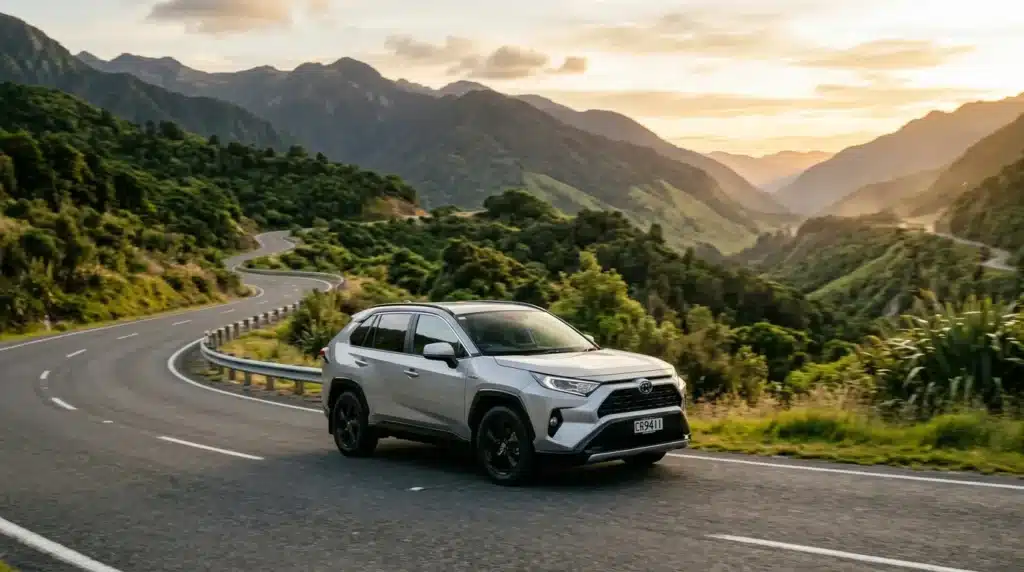
The RAV4 Hybrid remains the benchmark. It’s comfortable, practical, genuinely efficient, and holds its value better than almost anything in this segment. The AWD system is seamless — you don’t notice it working, which is exactly how it should be.
The Kia Sportage Hybrid is the smart pick if you’re watching budget. A $10,000 price gap vs the RAV4 is significant, and while Kia’s hybrid system isn’t quite as refined, it’s more than capable for most NZ buyers.
If you can charge regularly and do lots of urban driving, the RAV4 PHEV justifies its premium. It can run electric-only for roughly 75km — enough for most Auckland or Wellington commutes on a single overnight charge.
Hybrid Fuel Savings Calculator
Estimate how much you could save annually by switching to a hybrid.
Estimate only. Based on constant petrol price. Actual savings vary by driving style and conditions.
Toyota vs the Rest: Which Hybrid Brand Delivers in NZ?
Toyota owns the hybrid market in New Zealand, and for good reason. Their system — Toyota Hybrid System (THS-II) — has been in production since 1997. That’s nearly three decades of real-world refinement.
Toyota’s advantage: The hybrid components (battery, inverter, electric motors) are engineered to last the life of the car. There are countless NZ taxi fleets running Prius and Camry Hybrids past 400,000km with original batteries. That reliability track record is hard to argue with.
But the competition has caught up considerably:
Hyundai/Kia now offer competitive hybrid systems with excellent warranties — 5-year unlimited km on the car, 8 years on the high-voltage battery. Fuel economy isn’t quite Toyota-level, but the gap has narrowed. Their turbocharged hybrid engines also deliver more spirited performance.
Honda’s e:HEV is genuinely impressive. Honda’s dual-motor system feels smooth and efficient, and the Jazz e:HEV in particular is exceptional value in the small car segment.
Mitsubishi PHEV technology is a different beast entirely — their Eclipse Cross PHEV uses a generator-style petrol engine paired with large electric motors. Polarising, but very effective for pure EV driving on short runs.
My honest take: if reliability over 150,000+ km is your main concern, Toyota is still the safest choice. If you want performance, features, and competitive pricing, Hyundai and Kia are serious contenders. Honda splits the difference well.
Top Hybrid Models: NZ Comparison
Scores based on NZ owner feedback, VFACTS reliability data, and Trade Me resale trends. Prices indicative, verify with dealer.
Should You Buy New, Demo, or Used Hybrid in NZ?
This is a genuinely important decision, and the hybrid market makes it more nuanced than for regular petrol cars.
Buying new gives you full manufacturer warranty, the latest safety tech, and no battery uncertainty. For Toyota hybrids, the battery warranty is typically 5 years / 150,000km (extendable). Worth it if you’re keeping the car 7+ years.
Demo or ex-fleet (under 10,000km, 12–18 months old) can save you $5,000–$8,000 off list price. These are often ex-rental or company cars and come with remaining new-car warranty. Strong value if the kilometre count is low.
Used hybrid (3–5 years old) is where I see the best overall value in 2026. A 2021 Toyota RAV4 Hybrid with 50,000km is trading around $52,000–$58,000 on Trade Me — roughly $8,000–$14,000 below new price. The Toyota hybrid system at that age is still well within its reliable life. I’d prioritise getting a full service history over the lowest price.
One thing to check on used hybrids: Ask for a state-of-health (SoH) report on the high-voltage battery. Some dealers and independent mechanics now offer this. A battery above 80% SoH has plenty of life left. Below 70% is worth negotiating hard on price or walking away.
PHEV vs Self-Charging Hybrid: Which Is Right for NZ in 2026?
The honest answer depends on your daily driving pattern and whether you have access to home charging.
Choose a self-charging hybrid if:
- You drive mixed urban and motorway routes
- You don’t have reliable access to a home charger or overnight parking with power
- You want zero charging admin and simple ownership
- Your daily distance varies and is often over 60km
Choose a PHEV if:
- You drive under 50km most days and can charge overnight at home
- You have workplace charging available
- You want to run in pure EV mode for short daily commutes
- You’re prepared to manage charging discipline — PHEVs sip fuel if you never charge
The PHEV trap in NZ: I’ve spoken to plenty of RAV4 PHEV owners who rarely charge. On petrol-only, the RAV4 PHEV returns about 7.5L/100km — worse than the standard hybrid. You’re paying a $9,000 premium for a system you’re not using. Only buy the PHEV if you’ll actually charge it.
For most New Zealanders, a self-charging hybrid is the pragmatic choice. It works everywhere, costs less, and delivers genuine fuel savings without any behavioural change.