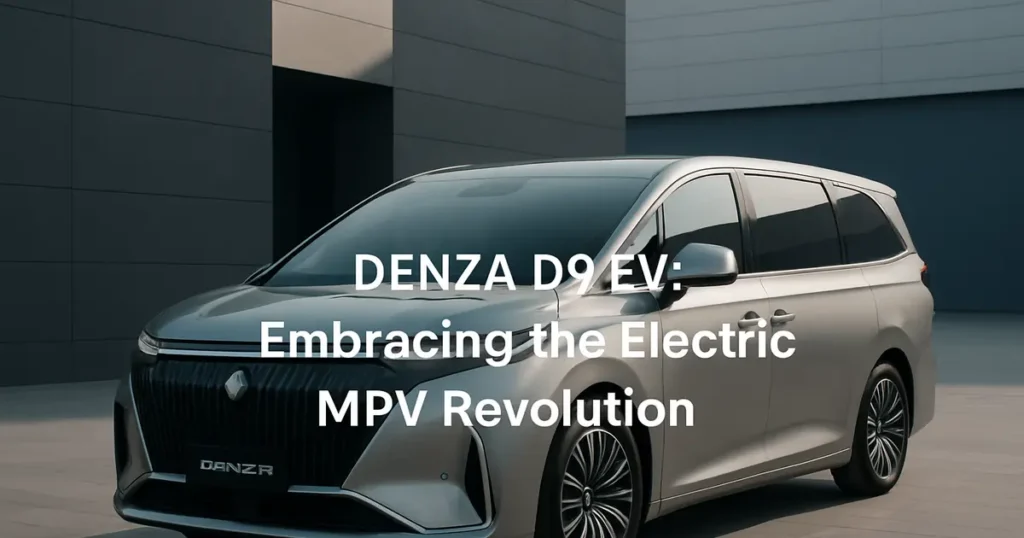
The seven-seater family vehicle market in New Zealand is changing fast. For years, Kiwi families choosing a spacious people-mover faced the same shortlist: a Toyota Alphard, a Hyundai Staria, or a used Japanese import van. Now, a serious new contender has entered the conversation — and it runs entirely on electricity.
I’ve been following the DENZA D9 EV closely since it started appearing on NZ roads, and I’ll be honest: it surprised me. I expected it to be another “good enough” Chinese EV. What I found was a genuinely premium, well-engineered machine that deserves serious consideration from any Kiwi family weighing up their next large vehicle purchase.
In this article, I’ll walk you through everything you need to know about the DENZA D9 EV — from who makes it and what it drives like, to real-world range on NZ roads, ownership costs, and who I think will get the most out of one.
What Is the DENZA D9 EV and Why Should Kiwis Pay Attention?
DENZA is a premium sub-brand of BYD, the Chinese automaker that has rapidly become one of the world’s best-selling EV manufacturers. The brand was originally a joint venture between BYD and Mercedes-Benz, and while Mercedes has since exited the partnership, that heritage shows in the D9’s interior quality and design language.
The D9 is a large electric MPV — think of it as BYD’s answer to the Toyota Alphard, but with zero tailpipe emissions and a seriously impressive spec sheet. It seats up to seven passengers across three rows, and the 90 kWh battery pack gives it a claimed WLTP range of around 550 km — enough to drive from Auckland to Wellington on a single charge in ideal conditions.
For Kiwi families who’ve been waiting for an electric people-mover that doesn’t compromise on space, comfort, or practicality, the DENZA D9 is probably the most compelling option available right now. That’s not a small statement, and it’s one I make after looking closely at what else is on the market.
Performance and Driving Feel on NZ Roads
The first thing that strikes you when you drive the DENZA D9 EV is how composed it feels for a vehicle this size. It’s not a sports car — nor should it be — but the 180 kW electric motor and instant torque delivery make it feel far more responsive than any diesel minivan I’ve driven.
Key performance figures:
| Spec | Detail |
|---|---|
| Motor output | ~180 kW (240 hp) |
| 0–100 km/h | ~7.5 seconds |
| Drive layout | Front-wheel drive (AWD available) |
| Top speed | 160 km/h (electronically limited) |
On the open road — cruising at 100 km/h on State Highway 1 — the D9 is whisper quiet. Wind and tyre noise is well suppressed, and the suspension soaks up New Zealand’s imperfect road surfaces without jarring passengers in the second or third row. That matters a lot when you’ve got kids or elderly passengers in the back.
Around town, the electric drivetrain really shines. No gear changes, no hesitation, no engine noise when you’re nudging through school-zone traffic at 40 km/h. Regenerative braking can be adjusted to suit your preference, and I find a moderate setting works well for urban driving — it slows the car meaningfully without feeling abrupt.
If you’re replacing a diesel Staria or V6 Alphard, the driving experience is genuinely better in almost every way.
Battery, Range, and Charging in the NZ Context
Range anxiety is the question I get asked about most with any EV, and it’s worth being honest: the DENZA D9’s 550 km WLTP figure is a manufacturer’s best-case number. Real-world range — especially with a full load of passengers, at motorway speeds, or in winter — will be lower. In my experience, expect something closer to 420–480 km in mixed NZ driving conditions.
That said, 420 km is still more than enough for the vast majority of Kiwi day-to-day use. The Auckland–Hamilton–Tauranga triangle, Wellington urban area, or Christchurch to Timaru and back — all comfortably doable on a single charge.
Charging options for NZ owners:
- Home wallbox (AC 7–11 kW): The best daily setup. A 7 kW charger takes around 12 hours for a full charge — perfect for overnight top-ups. Installation by a registered electrician typically costs NZD $1,200–$2,000 including the unit.
- DC fast charging (120 kW): Takes the battery from 10–80% in approximately 40 minutes. ChargeNet and other NZ public networks are expanding rapidly, and the D9 is compatible with the CCS2 standard used across NZ.
- Household 3-pin outlet: Possible in an emergency, but at 2.4 kW it’s slow — around 37 hours for a full charge. Not practical as a regular solution.
For longer NZ road trips, I’d plan charging stops using the ChargeNet or PlugShare apps. A Wellington to Taupō run, for instance, works well with a 30–40 minute stop at the Levin or Bulls fast charger. The D9’s larger battery means you can space stops further apart than smaller EVs.
One tip I always give D9 owners: pre-condition the cabin while still plugged in during winter. Heating a cold interior from battery reserve is expensive in range terms. Do it while you’re charging and you preserve those kilometres for driving.
Interior: Space, Comfort, and Tech That Actually Works
This is where the DENZA D9 genuinely earns its premium positioning. Step inside and it doesn’t feel like a utilitarian people-mover — it feels like a lounge on wheels.
Seating and space:
– 7-seat configuration across three rows (2-2-3 or 2-3-2 depending on variant)
– Flat floor throughout the cabin — no transmission tunnel hump, easy rear access
– Heated and ventilated front seats with lumbar support as standard
– Second-row captain’s chairs in premium trim — proper leg room, recline, and armrests
Tech and infotainment:
– 12.8-inch central touchscreen — responsive, sharp, and logically laid out
– Wireless Apple CarPlay and Android Auto — no fiddling with cables
– Over-the-air software updates — the vehicle improves after purchase
– Wi-Fi hotspot for in-car connectivity
– Rear-seat entertainment screens available on higher trims
Comfort features:
– Panoramic glass roof floods the cabin with light — a genuine mood lifter
– Multi-zone climate control — the front and rear can be set independently
– Ambient lighting with selectable colour modes
– Noise isolation is genuinely impressive — road and wind noise are well suppressed
I especially appreciate the rear-seat entertainment system on long family drives. It transforms the back rows from a source of complaints into a genuinely pleasant place to sit.
The boot space is generous even with all three rows up — enough for a family’s weekend luggage. Fold the rear rows and you have a cavernous cargo area that rivals a small van.
Safety Tech: Built for Modern NZ Roads
New Zealand’s road safety record is something we all have an interest in improving. The DENZA D9 comes loaded with advanced driver assistance systems (ADAS) that genuinely help.
Standard safety features:
- Automatic Emergency Braking (AEB) — detects vehicles, pedestrians, and cyclists. In a test environment, the system responded quickly and confidently.
- Adaptive Cruise Control with stop-and-go — ideal for Auckland motorway crawl
- Lane Keep Assist and Lane Departure Warning
- Blind Spot Detection with safe-exit alert (warns you before opening the door into traffic)
- 360° camera system — essential in a vehicle this size when manoeuvring in tight supermarket car parks or narrow driveways
| Safety Feature | Real-World Benefit |
|---|---|
| 360° camera | Parking a large van in tight NZ driveways |
| Rear Cross-Traffic Alert | Reversing safely out of angled parks |
| Traffic Sign Recognition | Speed limit reminders on unfamiliar roads |
| AEB with cyclist detection | Critical on busy NZ urban streets |
The overall safety package is what I’d expect from a vehicle in this price bracket — comprehensive, well-calibrated, and reassuringly present rather than intrusive.
Ownership Costs: What Running a DENZA D9 EV Really Costs in NZ
This is the section that often flips the decision for Kiwi buyers who’ve been sitting on the fence. EVs have a reputation for being expensive upfront, but the ongoing running costs tell a different story.
Fuel savings:
Charging from flat to full (90 kWh) costs roughly NZD $25–$27 at the average NZ residential electricity rate of around 28 c/kWh. Compare that to filling a 70-litre petrol tank at current NZ prices — you’re looking at NZD $145–$160. Over 15,000 km per year, the fuel saving alone is significant.
Maintenance:
Electric drivetrains have far fewer moving parts than combustion engines. No oil changes, no timing belts, no exhaust system to rot out. Brake pads last longer thanks to regenerative braking. The primary ongoing service items are tyres, wiper blades, cabin air filters, and the general safety check required for WOF.
Road User Charges (RUC):
From April 2024, EVs in New Zealand are subject to Road User Charges — currently NZD $53 per 1,000 km for light EVs. Factor this into your running cost calculations. Over 15,000 km/year, that’s approximately $795 annually. It’s a real cost, but still well below the fuel savings.
Warranty:
- Vehicle: 5 years / 100,000 km
- Battery: 8 years / 160,000 km
That battery warranty is important. It gives meaningful protection against the depreciation risk that makes some buyers nervous about used EVs.
Is the DENZA D9 EV the Right Choice for Your Kiwi Family?
The DENZA D9 EV is a strong vehicle, and I think it’s best suited to a specific type of Kiwi buyer. If any of the following describes you, it’s worth a serious test drive:
- You regularly carry 5 or more passengers and need genuine third-row comfort
- You want to switch away from petrol or diesel without giving up a large, capable family vehicle
- Your household does moderate to high annual kilometres where fuel savings add up quickly
- You have home charging available or are willing to install a wallbox
On the other hand, if you live rurally with limited access to fast charging infrastructure, or if most of your driving involves frequent long-distance runs without charging stops, the D9 may require more route planning than you’d like.
The NZ market for premium electric MPVs is still finding its feet, and the DENZA D9 is competing on genuine merit — not just novelty. For the right family, it’s a vehicle that will improve every school run, road trip, and weekend away for years to come. If you have questions about whether it fits your situation, drop them in the comments — I’m happy to help you work through it.