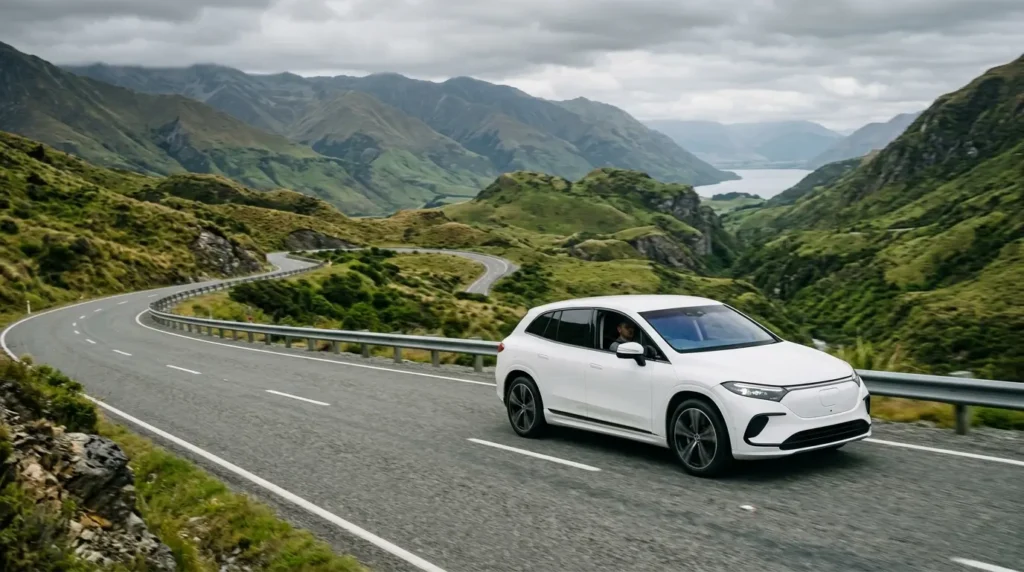
Leapmotor is about to become one of the most interesting EV brands in New Zealand — and most people haven’t heard of them yet. That’s about to change.
This Chinese EV maker has Stellantis — the group behind Peugeot, Citroën, Jeep, and Fiat — as a major shareholder. That means Leapmotor cars are arriving in NZ with proper dealership backup, parts supply, and long-term support. In a market where some Chinese EV brands have quietly struggled with servicing, that distinction matters.
In this guide, I’ll break down which models are heading to NZ, what you can realistically expect to pay, how they compare to the BYD Atto 3 and MG ZS EV, and whether Leapmotor is worth taking seriously as a buying decision in 2026.
What Is Leapmotor — And Why the Stellantis Backing Matters
Leapmotor was founded in 2015 in Hangzhou, China, with a focus on affordable, technology-forward electric vehicles. In 2023, Stellantis invested €1.5 billion for a 21% stake and co-created Leapmotor International — a joint venture specifically set up to sell Leapmotor vehicles outside China.
This is a bigger deal than it sounds. Stellantis already has an established dealer and service network in New Zealand. That means Leapmotor cars won’t be sold through new pop-up importers with uncertain futures. Warranty claims, parts sourcing, and servicing run through an accountable, existing network — something NZ buyers should weigh carefully before committing to any newer brand.
Leapmotor launched its first international models in Europe in late 2024. New Zealand is expected to follow through local Stellantis partners, with market entry confirmed for 2025–2026. It’s a more structured and considered arrival than what we’ve seen from some other Chinese brands that entered NZ on a shoestring.
The brand’s philosophy is vertical integration — they design and manufacture most core components in-house, including the battery management system, electric motors, and key electronics. That’s an advantage for cost control and long-term parts availability, even if it means less name-brand component recognition.
Leapmotor Models Coming to NZ: C10, B10, and T03 Explained
Three models make up Leapmotor’s international lineup, each targeting a different type of buyer:
Leapmotor C10 — The One Most Likely to Succeed in NZ
The C10 is the headline model and the most relevant for NZ buyers. It’s a mid-size electric SUV with genuine range and practical proportions — roughly the same footprint as a Hyundai Tucson or Toyota RAV4. This is the model going head-to-head with the BYD Atto 3.
- Battery: 69.9 kWh (CATL cells)
- Range: ~420 km WLTP
- Power: 160 kW / 320 Nm
- 0–100 km/h: 7.5 seconds
- DC fast charging: up to 80 kW
- AC charging: 11 kW (three-phase)
- Expected NZ price: $49,990–$54,990
Leapmotor B10 — Compact SUV for Urban Buyers
The B10 is a smaller SUV — think city-friendly dimensions with around 320 km of WLTP range from a 42 kWh battery. It’s aimed at buyers who don’t need maximum range and want a lower entry price. Expected under $45,000 NZD once officially launched.
Leapmotor T03 — Affordable City EV
The T03 is a compact city car with a 37.3 kWh battery and around 265 km of WLTP range. At an estimated $30,000–$35,000 NZD, it could meaningfully challenge the affordable EV segment in NZ — though its small size and modest range suit urban commuters, not regional drivers.
Leapmotor C10 Range and Specs — What the Numbers Mean in NZ
The 420 km WLTP figure on the C10 sounds excellent. In real-world NZ driving — highway speeds of 100 km/h, hilly terrain, varying temperatures — expect 340–370 km of usable range.
Auckland to Hamilton? Comfortable. Auckland to Tauranga? Doable without charging. Auckland to Wellington in one charge? Not a chance — you’ll need at least one stop, same as most EVs in this class.
The 80 kW DC fast charging speed means a 20–80% charge takes roughly 35–40 minutes at a compatible fast charger. That’s adequate for road trips but not class-leading — the Tesla Model Y charges significantly faster, and even some BYD models handle higher charge rates.
Where the C10 genuinely stands out is its 11 kW AC onboard charger. Most competitors in this price band offer 7.4 kW. On a three-phase home setup, the C10 adds around 66 km of range per hour — a full charge from 20% overnight takes about 5.5 hours. For most NZ buyers who charge at home overnight, this is a real practical advantage.
NZ road user charges (RUC) apply to all EVs from 2025. At the current rate of $76 per 1,000 km, budget approximately $760 per year if you’re driving 10,000 km annually. Factor this into your true running cost comparison against petrol alternatives.
How Leapmotor C10 Compares to BYD Atto 3 and MG ZS EV in NZ
Leapmotor C10 vs BYD Atto 3 vs MG ZS EV — NZ Spec Comparison
Leapmotor C10 vs BYD Atto 3 vs MG ZS EV — NZ spec comparison — Kiwi Motor Hub
On paper, the C10 has the edge in battery size and AC charging speed. The BYD Atto 3 beats it on DC fast charging and comes in slightly cheaper. The MG ZS EV trails on range but is the most affordable entry point.
My honest take: If you’re buying purely on specs and budget, the BYD Atto 3 is still the safer, more proven choice in NZ. The Leapmotor C10 is compelling if its NZ pricing lands at or below Atto 3 territory — but until it’s officially launched and priced, the Atto 3 has the advantage of a known quantity.
Leapmotor EV Running Cost Calculator for NZ
How much will a Leapmotor actually cost to charge and run in NZ? Use this calculator to estimate your annual costs based on your driving habits and electricity rate.
Leapmotor NZ Annual Running Cost Estimator
Estimates based on Leapmotor C10 real-world consumption ~17.5 kWh/100km. Petrol comparison assumes 10L/100km at $2.45/L. RUC at $76/1,000 km — Kiwi Motor Hub
Warranty, Servicing, and Parts in NZ — The Honest Picture
For any new brand entering NZ, the servicing story matters more than the spec sheet. A great EV with unreliable local support is a risk not worth taking.
Leapmotor International offers:
- 5-year / 150,000 km vehicle warranty
- 8-year / 160,000 km battery warranty
- Service through Stellantis-affiliated dealer networks in NZ
The battery warranty is strong — matching or beating BYD (8 years / 160,000 km) and exceeding MG (7 years / unlimited km on battery). The 8-year coverage gives meaningful protection against battery degradation, which remains the biggest long-term cost concern for EV buyers in NZ.
The Stellantis dealer network in NZ handles Peugeot and Citroën, and those dealers are trained by the same parent company overseeing Leapmotor International. That’s not a perfect situation — these dealers won’t have Leapmotor-specific expertise on day one — but it’s significantly better than an independent importer with no manufacturer backing.
Parts supply is the remaining unknown. NZ is a small, remote market. Fast-moving parts availability depends entirely on how seriously Stellantis commits to local stock levels. Before signing a purchase agreement, ask your dealer directly: what’s the lead time for a replacement front door or suspension arm?
I’d also recommend checking whether your insurance provider has experience quoting Leapmotor before you buy. New brands sometimes attract higher premiums simply due to unfamiliarity with parts costs.
The honest position: Leapmotor has better service infrastructure than most Chinese brands currently entering NZ. But it’s still early days. If you’re an early adopter who accepts that reality, the value proposition is compelling. If you need rock-solid dealer support from day one, give it another 12–18 months and let the first wave of buyers iron out the wrinkles.