If you’ve been searching for a ute that doesn’t feel like a punishment to drive every day, you’ve probably landed on the Honda Ridgeline. It’s one of the most misunderstood vehicles available in New Zealand — dismissed by some as “not a real ute,” but quietly loved by owners who actually live with one.
The truth is, whether a Ridgeline suits you depends entirely on how you use a ute. I’m going to cut through the noise and give you a straight answer: what it does well, what it doesn’t, what it costs in NZ, and who should actually buy one.
What Makes the Honda Ridgeline Different From a Typical Ute?
The Ridgeline is built on a car-based unibody platform — the same approach Honda uses for the Pilot SUV. Every other popular ute in NZ (Ford Ranger, Toyota Hilux, Isuzu D-Max) uses a traditional body-on-frame construction, where the cab sits on top of a separate steel ladder frame.
This single difference changes everything about how the vehicle rides, handles, and performs.
What unibody gives you:
- Car-like ride quality on sealed roads
- Better handling around corners and at highway speeds
- A quieter cabin with less vibration and road noise
- Lower centre of gravity for stability
What you give up:
- Heavy-duty off-road capability
- High towing and payload ratings
- The ability to handle serious abuse on farm tracks or worksites
The Ridgeline isn’t trying to compete with the Ranger or Hilux on their terms. It’s a lifestyle ute — and if you understand that going in, you’ll be much happier with it.
Honda Ridgeline Specs: Engine, Towing & Payload (2017–2026 Models)
The second-generation Ridgeline (2017 onwards) is what you’ll find as a grey import in NZ. All models share the same drivetrain.
| Spec | Honda Ridgeline (2nd Gen) |
|---|---|
| Engine | 3.5L VTEC V6 Petrol |
| Power | 214 kW (287 hp) |
| Torque | 355 Nm |
| Transmission | 6-speed automatic |
| Drive | AWD (i-VTM4) |
| Towing Capacity | Up to 2,268 kg (with TBC equipped) |
| Payload | ~453 kg |
| Fuel Consumption | ~11.5L/100km (combined) |
| Bed Length | 1,524 mm |
| Seats | 5 |
The i-VTM4 AWD system actively transfers torque between the rear wheels, not just between front and rear axles. In practice, this gives the Ridgeline surprisingly capable traction in wet and loose conditions — useful on the back roads that many Kiwis deal with regularly.
One major practical feature you won’t find on any other ute: a lockable in-bed trunk (60 litres) under the floor of the tray. It keeps tools, valuables, or wet gear completely hidden and weather-protected.
The dual-action tailgate swings both down (like a traditional ute) and sideways (like a door), which makes loading awkward items significantly easier.
How Does the Honda Ridgeline Drive on NZ Roads?
This is where the Ridgeline genuinely separates itself from the rest of the ute market.
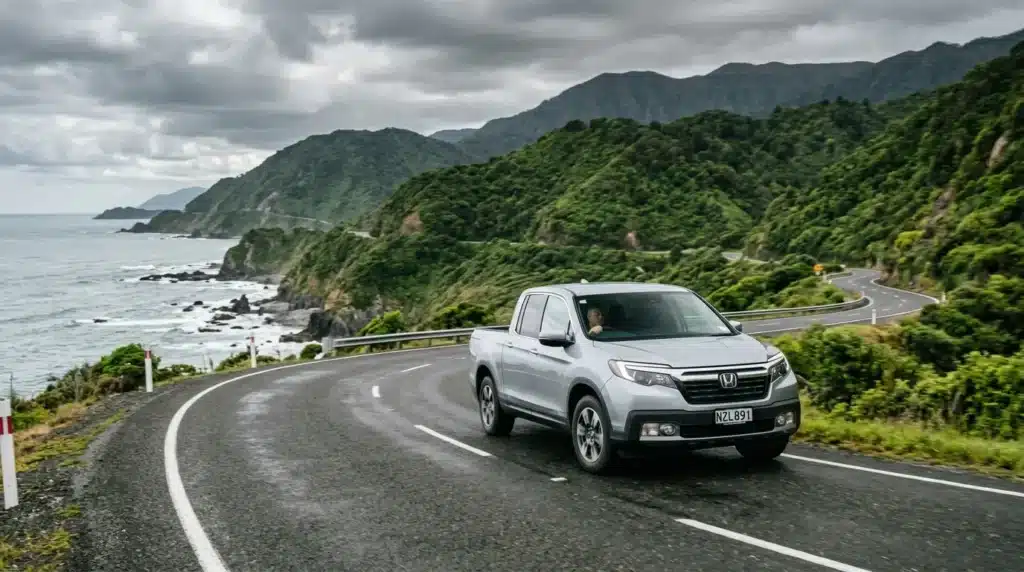
On NZ’s sealed roads — whether you’re commuting in Auckland, running the Kapiti Coast, or doing regular highway runs between cities — the Ridgeline drives like an SUV. The ride is smooth, the steering is responsive, and the cabin is quiet at speed. There’s none of the bouncing or wallowing you get from a lightly-loaded Ranger on a bumpy road.
The 3.5L V6 is punchy and responsive without needing to push hard. Overtaking feels easy, and the engine sounds good when you do. That said, it is thirsty — expect real-world fuel use of 11–13L/100km depending on driving style.
Where it’s less impressive:
- Unsealed roads with corrugations or deep ruts will expose the softer suspension
- It’s not designed for heavy farm use or regular off-road driving
- The ~453kg payload limit means you can’t work it like a Ranger or Hilux
For urban or lifestyle buyers who occasionally head off the beaten track, it handles NZ conditions well. For regular rural or worksite use, you’d want something with a higher payload.
Honda Ridgeline vs Ford Ranger vs Toyota Hilux: Which One Wins?
Honda Ridgeline vs Ford Ranger vs Toyota Hilux — Key Specs Compared
Ratings are relative to class; payload/towing figures are approximate. Always verify with your dealer or compliance plate.
The honest verdict: If you need to tow a boat over 2,000kg or regularly carry heavy loads, the Ridgeline isn’t the right tool. The Ranger and Hilux both offer 3,500kg towing and roughly double the payload — and diesel engines are more economical for high-kilometre highway and rural use.
But if you drive mostly on sealed roads, rarely need more than 450kg of payload, and want a ute that doesn’t beat you up on the daily commute, the Ridgeline is genuinely hard to beat.
Honda Ridgeline NZ Price: What to Expect in 2026
The Ridgeline is not officially sold by Honda NZ dealers. All Honda Ridgelines in NZ are grey imports, predominantly from the United States, Canada, or Japan.
This means pricing is set by the used import market — primarily Trade Me and specialist import dealers.
Typical Trade Me pricing (April 2026):
| Year / Variant | Approx. NZD Price |
|---|---|
| 2017–2018 RTL / RTL-E | $32,000–$42,000 |
| 2019–2020 Sport / RTL | $40,000–$52,000 |
| 2021–2022 Sport / Black Edition | $50,000–$62,000 |
| 2023–2024 Sport / TrailSport | $62,000–$75,000+ |
Prices vary based on odometer, condition, compliance costs, and whether the vehicle has already been NZ-registered or is freshly imported.
What to check before buying:
- Compliance plate — every import must be complied to NZ standards. Confirm this has been done by a certified NZ workshop.
- Odometer history — US imports can have high kilometres for the age. Request a Carfax or AutoCheck report.
- WoF and registration — ensure these are current or factor in the cost.
- Water damage history — US vehicles can come from flood-affected states. Check thoroughly.
- Towing Brake Controller — the Ridgeline’s higher 2,268kg tow rating requires TBC to be installed. Verify it’s fitted if towing is important to you.
I’d recommend buying a compliance-plated, NZ-registered example where possible — it removes the uncertainty and saves you from dealing with compliance yourself.
Honda Ridgeline Running Costs & Annual Fuel Estimate for NZ Drivers
This is where the Ridgeline surprises some buyers — not always in a good way.
The 3.5L V6 drinks petrol. At 15,000km per year, you’re looking at around 9–12 litres per 100km depending on whether you’re doing city or highway driving. Here’s the annual fuel cost picture versus the diesel alternatives:
Key advantage: As a petrol vehicle, the Ridgeline does not pay Road User Charges (RUC). Diesel utes in NZ pay around $76 per 1,000km in RUC — which adds roughly $1,140/year for a 15,000km driver. Factor that in, and the gap closes.
Use the calculator below to estimate your own annual fuel costs:
Honda Ridgeline Annual Running Cost Estimator
Servicing costs for the Ridgeline in NZ are straightforward. Honda’s V6 engines have a strong reliability record, and parts availability — while not as widespread as Toyota — is reasonable through Honda dealers and independent importers. Expect to service every 12 months or 10,000km with genuine Honda parts, at a cost similar to other mid-size petrol SUVs.
Reliability: The second-gen Ridgeline shares its drivetrain with the Honda Pilot and Odyssey — both of which have excellent long-term reliability records. The i-VTM4 AWD system and 6-speed auto are proven units. There are no widespread reported issues specific to NZ-imported examples, though you should always request a full pre-purchase inspection from a qualified mechanic before buying any grey import.
Who Should Buy the Honda Ridgeline in NZ?
Buy it if you:
- Drive mostly on sealed roads and want a comfortable daily driver
- Occasionally need to haul gear or tow a trailer up to ~2,000kg
- Want ute practicality (open tray, towing point) without farm-truck dynamics
- Value the in-bed trunk and dual-action tailgate for clever storage
- Don’t mind paying slightly more for fuel versus a diesel alternative
Look elsewhere if you:
- Regularly tow boats, horse floats, or trailers over 2,300kg
- Work on-site and need to carry 800kg+ of materials regularly
- Drive unsealed rural roads frequently
- Need a vehicle you can have serviced at any rural town in NZ
The Ridgeline is one of the few utes I’d confidently recommend to someone who actually spends 90% of their time on-road. It does that part of the job better than anything else in the segment. Just be clear-eyed about what it isn’t — and you won’t be disappointed.