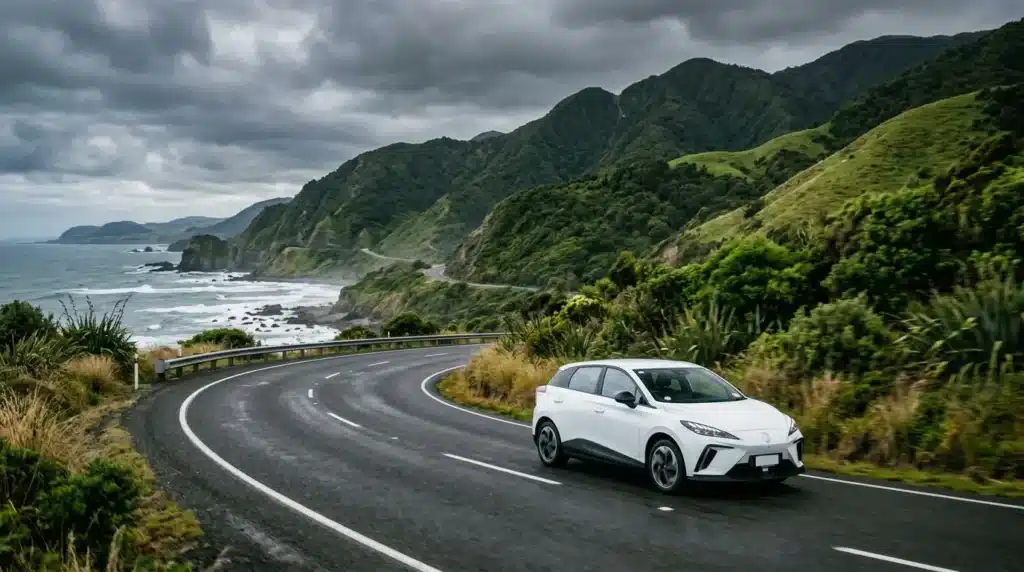
If you’re shopping for an affordable EV in NZ right now, the MG4 deserves a serious look. It’s one of the few electric cars under $50,000 that doesn’t feel like a compromise — the range is real, the interior is a step up from the older MG ZS EV, and the driving experience is genuinely fun.
But it’s not perfect. The charging speed lags behind rivals, the interior plastics are a mixed bag, and MG’s brand perception in NZ is still catching up to the quality of the actual car. I’ve spent time with the MG4 across city driving and longer open-road runs to give you a straight answer on whether it’s worth your money.
Here’s what you need to know before you sign anything.
MG4 EV Variants in NZ: Which One Should You Choose?
MG sells the MG4 in New Zealand in three main variants. The difference between them matters more than the name suggests.
| Variant | Battery | Range (WLTP) | Power | NZ Price (approx.) |
|---|---|---|---|---|
| MG4 EV Excite 64 | 64 kWh | 435 km | 150 kW / 250 Nm | ~$40,990 |
| MG4 EV Essence 64 | 64 kWh | 435 km | 150 kW / 250 Nm | ~$44,990 |
| MG4 EV XPOWER | 64 kWh | 385 km | 320 kW / 600 Nm (AWD) | ~$54,990 |
The Excite 64 is the sweet spot for most buyers. You get the full 64 kWh battery and 435 km of WLTP range at the lowest entry price. The Essence adds heated seats, a larger touchscreen, and a more premium finish — worth it if you’re keeping the car long-term.
The XPOWER is a different beast: dual motors, AWD, 0–100 km/h in 3.8 seconds. It’s genuinely quick. But you’re paying $14,000 more than the Excite, and the shorter range (385 km) means it’s best suited to enthusiasts rather than pure-utility buyers.
My recommendation: Start with the Excite 64. If you find yourself wanting more comfort features during a test drive, step up to the Essence. Skip the XPOWER unless performance is your primary motivation.
What’s the MG4 EV Like to Drive on NZ Roads?
The MG4 is built on SAIC’s MSP (Modular Scalable Platform), which means the battery sits in the floor, keeping the centre of gravity low. You feel this immediately. It handles corners with more confidence than you’d expect from a family hatchback at this price point.
Around Auckland and Wellington city streets, the one-pedal driving mode is well-calibrated — smooth enough to use daily without jerking passengers around. Regenerative braking has three settings, and the strongest is strong enough that you rarely need to touch the brake pedal in urban traffic.
On the open road, the MG4 is composed and quiet. Wind noise at motorway speeds is noticeably lower than the MG ZS EV, which used to be a complaint. The suspension absorbs NZ’s patchy rural roads reasonably well, though sharp potholes do thud through the cabin.
Steering is light — some will find it too light. There’s no fake weight added through a “sport” mode, which I actually appreciate. It’s honest.
One genuine weakness: the turning circle is larger than you’d expect for a car this size, which becomes obvious when reversing out of tight NZ suburban driveways.
How Far Does the MG4 Really Go in New Zealand?
WLTP range figures always need interpreting for NZ conditions. The 435 km rating for the 64 kWh models is measured under European lab conditions. Here’s what you can realistically expect:
- City driving (Auckland/Wellington): 380–420 km. Stop-start traffic and regen work in your favour.
- Mixed driving (city + motorway): 330–370 km. A realistic daily-use figure for most Kiwis.
- Motorway at 100 km/h: 290–320 km. Speed is the biggest range killer — aerodynamic drag increases significantly above 90 km/h.
- Winter (South Island, 5–10°C): Expect 10–15% reduction, so around 270–310 km on motorways.
The 435 km WLTP figure is achievable only in ideal conditions. But even the conservative real-world estimate of 300 km is enough to cover most NZ inter-city trips — Auckland to Hamilton, Wellington to Palmerston North — with margin to spare.
Use the calculator below to estimate your real-world range based on your driving style:
MG4 EV Real-World Range Calculator (NZ)
Estimate based on WLTP rating adjusted for NZ driving conditions and temperature.
MG4 EV Running Costs vs Petrol: What You’ll Actually Save
This is where the MG4 makes a compelling case. Compared to a similarly-priced petrol hatchback or small SUV, the weekly running costs are significantly lower.
Here’s a comparison based on 15,000 km per year — a typical NZ driver:
| Cost | MG4 EV (64 kWh) | Toyota Corolla GX Petrol |
|---|---|---|
| Fuel/electricity per 100 km | ~$3.20 (home charging, 25c/kWh) | ~$10.80 (9L/100km @ $2.40/L) |
| Annual fuel cost (15,000 km) | ~$480 | ~$1,620 |
| Annual WoF | $60 | $60 |
| Road User Charges (RUC) | ~$450 (3c/km from 2024) | Included in fuel |
| Annual servicing | ~$250 | ~$500–$700 |
| Annual running cost (est.) | ~$1,240 | ~$2,280–2,480 |
You’re saving roughly $1,000–$1,200 per year in running costs with the MG4. Over a typical 5-year ownership period, that’s $5,000–$6,000 in savings — which meaningfully offsets the EV premium.
Note: RUC (Road User Charges) for EVs in NZ are currently set at 3.0 cents per km. Budget for this — it’s easy to overlook when comparing initial pricing.
Annual Running Cost: MG4 EV vs Petrol Rivals (15,000 km/yr)
Estimates based on 15,000 km/year. Petrol at NZ$2.40/L, home EV charging at 25c/kWh, RUC at 3c/km for EVs. Actual costs vary.
MG4 Charging in New Zealand: What You Need to Know
Charging is where the MG4 shows its one significant weakness. The maximum DC fast-charge speed is 117 kW for the 64 kWh models. That’s respectable but trails the BYD Dolphin’s 88 kW (slightly slower) and falls well behind the MG’s own XPOWER at 140 kW.
In practice, what does 117 kW charging mean?
- 10–80% charge: approximately 28–32 minutes on a compatible DC fast charger
- Typical public charge (20–80%): around 22–25 minutes
- AC home charging (11 kW): approximately 6.5 hours for a full charge from empty
For NZ road trips, the charging network has improved considerably. The main corridors (Auckland–Wellington, Christchurch–Queenstown) now have ChargeNet and other providers covering the route. The MG4 uses the CCS2 connector, which is compatible with the majority of public fast chargers in NZ.
Practical tips for MG4 charging in NZ:
- Install a home wallbox — 7 kW or 11 kW charger. It transforms the ownership experience. Budget ~$800–$1,500 installed.
- Avoid regular DC fast charging above 80% — charge curve slows significantly after 80% and it’s unnecessary for daily use.
- Use the scheduled charging feature to charge overnight during off-peak periods (some power companies offer EV night rates from ~18c/kWh).
- On road trips, plan stops at major towns rather than pushing to the limit. The ChargeNet app shows live charger availability.
How Does the MG4 Compare to Its Main NZ Rivals?
The MG4’s direct competitors in the NZ market are the BYD Dolphin, the Ora Funky Cat, and increasingly, the entry-level Tesla Model 3. Here’s an honest comparison:
MG4 vs NZ EV Rivals — At a Glance
Prices are approximate NZ drive-away as of early 2026. Specs based on manufacturer data.
Against the BYD Dolphin, the MG4 wins on charging speed (117 kW vs 88 kW) and matches it on range, while the Dolphin edges ahead on starting price and interior quality. If price is your absolute priority, the Dolphin. If you value faster public charging and a more dynamic drive, the MG4.
Against the Ora Funky Cat, the MG4 isn’t even close — significantly more range, faster charging, and similar pricing. The Funky Cat is only worth considering if you genuinely never drive more than 200 km in a day.
The Tesla Model 3 is in another league on range, charging (via Supercharger network), and software — but it’s $24,000 more. That gap is hard to justify unless you’re frequently doing long inter-city drives.
MG4 EV Interior, Tech, and Practicality for Kiwi Families
The MG4’s cabin is a significant step up from the old MG ZS EV. It doesn’t feel cheap, but it doesn’t feel premium either — it’s honest about what it is.
The 10.25-inch central touchscreen (Essence variant) is responsive and the interface is clean. Apple CarPlay and Android Auto are both included. The smaller screen on the Excite works but feels dated in comparison — worth factoring into your decision.
Boot space is 363 litres — adequate for a couple or small family doing weekly shopping, but it’ll feel tight for a family of four on a road trip. There’s no front storage compartment (frunk), which is a miss compared to some rivals.
Rear seat space is genuinely good for a car of this footprint. Two adults fit comfortably behind the front seats — that flat battery floor means no awkward transmission tunnel hump. Families with rear-facing child seats should check clearance, as the front seat rake is limited.
Safety is solid: the MG4 scored 5 stars in Euro NCAP testing. NZ ANCAP uses equivalent testing protocols, so this is a meaningful figure. Standard safety features across the range include:
- Autonomous Emergency Braking (AEB)
- Lane Keep Assist
- Blind Spot Monitoring (Essence and above)
- Rear cross-traffic alert
- 360-degree camera (Essence)
The 7-year / unlimited kilometre warranty is class-leading and deserves emphasis. Most competitors cap at 5 or 6 years and/or 150,000 km. If you’re planning to keep this car for the long haul, that warranty has real financial value.