Panel beating costs in NZ can be anywhere from $150 for a small paintless dent repair to $10,000+ for serious collision or rust work. That is a huge range, which is why the quote can feel confusing when all you can see is “one dent” or “a bit of rust”.
The honest answer is this: panel beating is priced by labour, paint, access, parts, and risk. A small supermarket dent on a flat door skin is one thing. Rust near a structural area, a creased quarter panel, or pearl white paint that needs blending across multiple panels is a very different job.
I have broken this down the way I would think about it before spending money: what common repairs cost, when insurance makes sense, what rust means for WoF, and when I would walk away from the repair altogether.
How much does panel beating cost in NZ in 2026?
For most everyday damage, panel beating cost NZ estimates usually sit between $300 and $2,500. Small cosmetic jobs can be cheaper, while insurance-level collision repairs can climb quickly once parts, paint blending and structural checks are involved.
Here is a realistic guide for private repairs in New Zealand:
| Repair type | Typical NZ cost | When it makes sense |
|---|---|---|
| Small paintless dent repair | $150-$400 | Paint is not cracked and the panel is accessible |
| Minor scratch repair | $250-$700 | Scratch has not gone deep into metal |
| Bumper scuff repair | $350-$900 | Plastic bumper is repairable, not split badly |
| One panel respray | $600-$1,400 | Paint is damaged but the panel is straight |
| Door or guard repair and paint | $700-$1,800 | Moderate denting without major inner damage |
| Bumper replacement and paint | $900-$2,500 | Clips, sensors, or plastic mounts are damaged |
| Rust repair, small non-structural area | $500-$1,500 | Rust is localised and can be cut out properly |
| Structural rust or collision repair | $2,500-$10,000+ | Safety areas, seams, pillars, rails, or chassis points are involved |
These are not fixed prices. A shop still needs to inspect the car, because the visible damage is often only part of the job.
The key point: if paint, parts and disassembly are involved, the price usually jumps from hundreds into four figures. That is normal, not automatically a rip-off.
Why dent repair cost NZ quotes vary so much
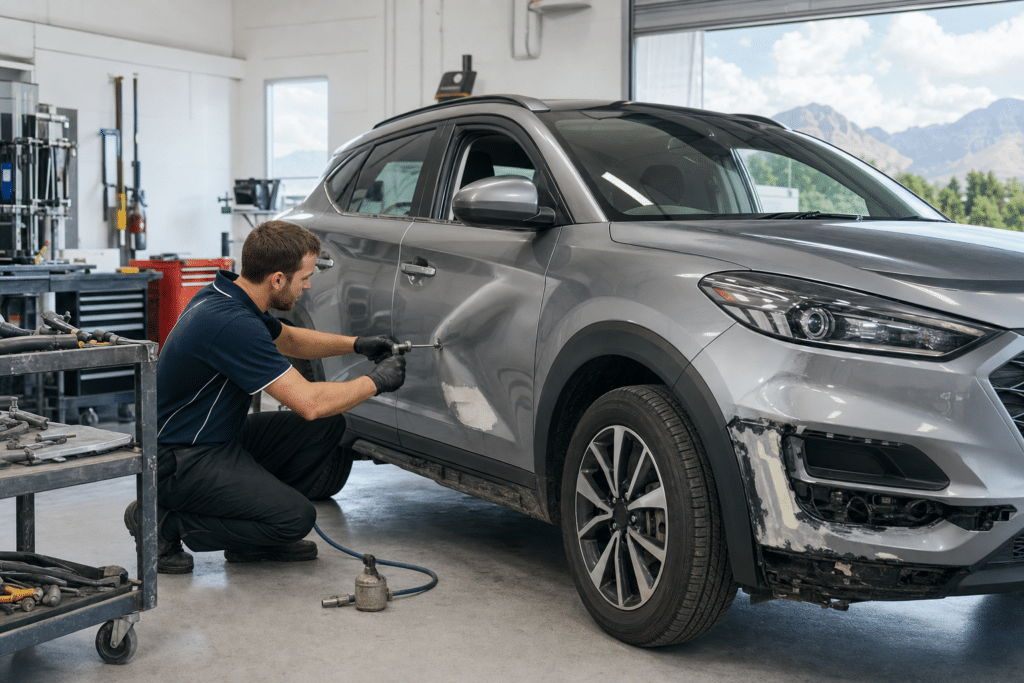
Dent repair cost in NZ depends heavily on whether the job can be done with paintless dent repair, often called PDR. If the paint is intact and the panel can be accessed from behind, PDR is usually the cheapest and cleanest repair.
PDR works best for:
- Small door dings
- Shallow supermarket trolley dents
- Hail dents
- Minor dents where the paint is not cracked
- Panels without sharp creases
It does not work well when:
- The paint is chipped or cracked
- The metal is sharply folded
- The dent sits on a panel edge or body line
- There is rust under the paint
- The panel has already been filled or repaired badly
That is why two dents that look similar from a distance can have very different prices. A soft dent on a door may be a $250 PDR job. A sharp dent through a crease line that needs sanding, filling, priming, painting and blending can easily become $900-$1,500.
My take: if the paint is not broken, always ask whether PDR is possible before agreeing to a full paint repair. It can save money and keeps the original factory paint intact.
Panel Beating Cost Estimator NZ
Estimate only. Real quotes depend on inspection, paint code, parts availability, rust depth, sensor calibration and labour time.
Scratch repair cost NZ: when a mark becomes a paint job
Scratch repair cost in NZ usually depends on depth. If the scratch is only in the clear coat, a cut and polish may be enough. If it has gone through the colour coat, the repair usually needs paint.
Here is the simple test: run your fingernail lightly across the scratch. If your nail catches, it is probably too deep for polishing alone.
Typical costs:
- Light polishable marks: $100-$300
- Stone chips or small touch-ups: $150-$500
- Bumper scuff repair: $350-$900
- Full panel repaint: $600-$1,400
- Multi-panel blend: $1,200-$3,000+
Pearl white, red, silver and some metallic colours can cost more because they are harder to match. On late-model cars, the panel beater may need to blend into the next panel so the repair does not stand out in sunlight.
My advice is direct: do not pay for a full panel respray if a polish or small touch-up will genuinely solve the problem. But if the scratch has gone through to metal, leaving it too long can invite rust, especially in coastal NZ areas.
Rust repair cost NZ and WoF risk
Rust is where panel beating stops being cosmetic and starts becoming a safety decision. A small rust bubble on a lower door skin is annoying. Rust near a pillar, sill, seatbelt mount, suspension point, subframe mount or structural seam is much more serious.
NZTA says a vehicle must be in good condition for WoF, including no rust around safety areas. NZTA repair certification guidance also treats structural damage and deterioration differently from simple cosmetic repair. You can read the official guidance through NZTA repair certification and NZTA car requirements.
That matters because a cheap rust patch can look fine for a few months and still fail the next WoF if the rust was not cut out properly.
Typical rust repair costs:
| Rust type | Typical NZ cost | My view |
|---|---|---|
| Small surface rust, non-structural | $250-$700 | Worth fixing early |
| Small cut-out and repaint | $500-$1,500 | Worth it if the car is otherwise sound |
| Rust around windscreen, roof edge or hatch | $1,000-$3,000+ | Get quotes before committing |
| Sill, pillar, floor or chassis-area rust | $2,000-$8,000+ | Be careful; may become uneconomic |
| Rust plus repair certification | Varies widely | Confirm the process before work starts |
The trap is paying for visible rust removal without asking what is underneath. If the repairer says "we will know once we strip it back", that is not necessarily evasive. Rust often spreads behind paint and seam sealer where you cannot see it.
My rule: if rust is near a structural or WoF-sensitive area, get a written quote and ask whether certification may be needed before the grinder touches the car.
Bumper repair cost NZ and hidden sensor costs
Bumper repair cost in NZ used to be relatively simple. Modern cars have changed that. A bumper is not just a plastic cover anymore; it may carry parking sensors, radar brackets, cameras, clips, air guides and impact absorbers.
A simple bumper scuff may cost $350-$900. A cracked bumper with parking sensors can move into $1,000-$2,500+, especially if the bumper needs replacing and painting.
The hidden costs are usually:
- Broken clips or brackets
- Damaged parking sensors
- Radar or camera calibration
- Paint blending into guards
- Replacement undertrays or liners
- Genuine parts delays
If your car has adaptive cruise control, lane assist, autonomous emergency braking, 360-degree cameras or parking sensors, ask the repairer whether any calibration is required. On newer cars, the cheapest bumper quote is not always the best quote.
The practical takeaway: for older cars, a tidy bumper repair can be a smart private job. For newer cars with sensors, insurance may be safer if the damage is more than cosmetic.
Typical NZ Repair Cost Ranges
These upper ranges are practical buyer-guide estimates, not fixed quotes. Structural work, parts delays, paint blending and certification can push costs higher.
Should you use insurance or pay privately?
Use insurance when the repair is clearly above your excess, when safety systems may be affected, or when the damage involves another vehicle. Pay privately when the repair is small and the insurance claim may cost you more long-term through excess, claim history or lost no-claims benefits.
Here is the way I would decide:
| Situation | Better option | Why |
|---|---|---|
| $250 door ding, no paint damage | Pay privately | Usually below most excess levels |
| $600 bumper scuff | Compare both | Depends on your excess and claim history |
| $1,500 door repair | Insurance likely | Cost is usually above excess |
| Multi-panel scrape | Insurance likely | Blending and labour add up quickly |
| Rust repair | Usually private | Insurance normally does not cover wear and tear |
| Structural collision damage | Insurance | Safety, documentation and certification matter |
If another driver caused the damage, document everything: photos, plate number, time, location, witness details and insurer information. If you are paying privately, still ask for a written quote and receipt.
The key point: do not claim tiny cosmetic damage automatically. A $350 private repair can be cheaper than triggering an insurance process for something your policy excess already covers.
What affects panel beater prices in Auckland, Wellington and Christchurch?
Panel beater prices vary by region, but not always in the way people expect. Auckland can be expensive because labour, rent and demand are high. Smaller towns may be cheaper, but parts access and specialist repair capacity can be more limited.
The biggest cost drivers are usually:
- Labour hours - stripping, aligning, filling, sanding and finishing take time.
- Paint work - colour matching, blending, clear coat and booth time add cost.
- Parts availability - genuine parts cost more, used parts may take time to find.
- Vehicle age - older cars may have brittle clips, hidden rust or discontinued parts.
- Safety systems - sensors and calibration can turn a simple repair into a technical one.
- Rust depth - surface rust is manageable; structural corrosion can spiral.
For Japanese used imports, parts can be affordable if there are many wrecked examples in NZ. For newer European cars, EVs, uncommon imports or cars with advanced driver-assistance systems, repair bills can rise quickly.
That is why I would get at least two quotes for anything over $1,000, and three quotes for rust or collision work. You are not just shopping for the cheapest number. You are checking whether each shop has understood the same repair.
How to choose a panel beater in NZ without getting caught out
A good panel beater should be able to explain the repair in plain English. If they cannot tell you whether the job is cosmetic, structural, paint-only, replacement, or rust-related, I would be cautious.
Before booking, ask:
- Is this a repair, replacement, or repaint?
- Will the paint need to be blended into nearby panels?
- Are used or aftermarket parts suitable?
- Is there any rust or hidden damage risk?
- Could this affect WoF or require repair certification?
- How long is the workmanship warranty?
- Will I get photos or records of the repair?
- Is the quote fixed, or could it change after strip-down?
For a cheap commuter car, a tidy functional repair may be enough. For a late-model vehicle, leased car, financed car, or anything you plan to sell soon, the repair quality matters more because poor colour match or visible filler can hurt resale.
The simplest filter is this: choose the repairer who explains the risk clearly, not just the one who gives the lowest price.
When panel beating is not worth it
Panel beating is not always the smart move. Sometimes the right decision is to leave cosmetic damage alone, sell the car honestly, or put the money toward a better vehicle.
I would think twice before repairing if:
- The repair is more than 30-40% of the car's market value
- Rust is structural or likely to return
- The car is near the end of its useful life
- The damage is cosmetic and does not affect WoF, safety or resale much
- The vehicle has existing mechanical problems
- Insurance has already marked it as uneconomic to repair
Example: spending $3,000 fixing rust and paint on a $5,000 hatchback rarely makes sense unless the car is otherwise excellent and you plan to keep it. But spending $700 fixing a dent before selling a $25,000 SUV may be worthwhile if it improves buyer confidence.
My final practical call: fix small damage early, get serious rust assessed properly, and do not pour big panel beating money into a car that is already worth less than the repair. That is the decision that saves the most money in the real world.