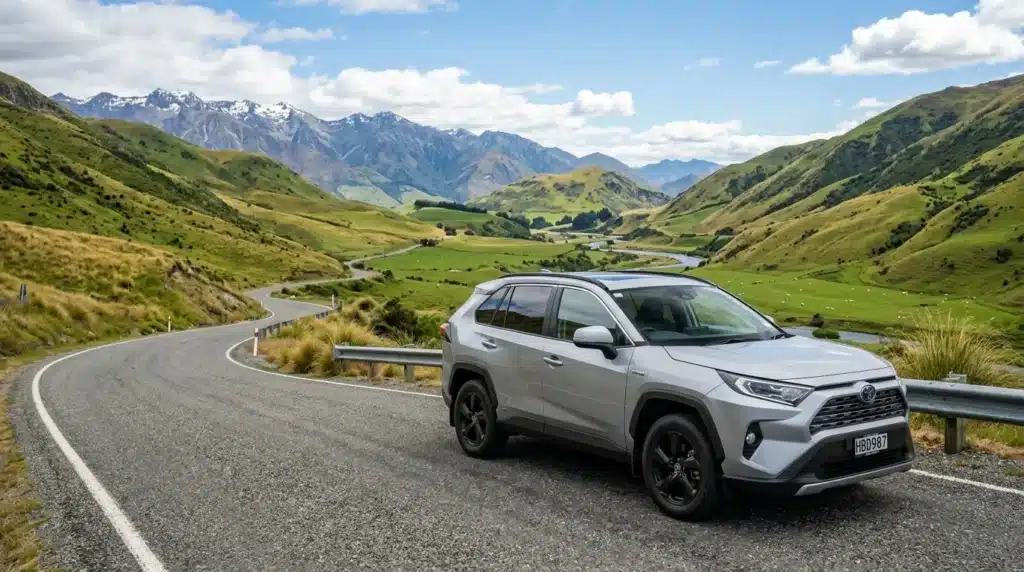
The Toyota RAV4 Hybrid is New Zealand’s best-selling hybrid SUV — and it’s not particularly close. Year after year it outsells every other hybrid in the segment, and for good reason. It delivers genuine fuel savings, a refined driving experience, and enough practicality for everyday family use — all without asking you to plug anything in.
But buying the right one matters. There are three trim levels in NZ, a price spread of around $18,000 between entry and top, and meaningful differences in features and value between them. I’ve put together everything you need to make the decision confidently: specs, real running costs, and a straight answer on which trim is actually worth the money.
Toyota RAV4 Hybrid Specs: How the Powertrain Works
The RAV4 Hybrid uses Toyota’s fifth-generation hybrid system — the same basic setup that’s earned a strong reliability reputation across Camry, Corolla, and Lexus models for two decades.
The core setup:
- A 2.5-litre four-cylinder petrol engine (DOHC, Atkinson cycle) — tuned for efficiency rather than peak power
- A front electric motor that works alongside the petrol engine during acceleration
- A rear electric motor that powers the back wheels independently — this is how AWD works on the RAV4 Hybrid. There’s no traditional prop shaft or transfer case. The rear wheels are driven purely by electricity, which makes the system lighter and smoother than conventional 4WD.
- A nickel-metal hydride battery pack under the boot floor — small enough not to cut into cargo space
Combined system output is 163 kW (219 hp), which is adequate for NZ motorway speeds and overtaking. It doesn’t feel particularly quick off the line — 0-100 km/h takes around 8 seconds — but it’s always smooth, and the transition between electric and petrol power is virtually imperceptible in normal driving.
| Specification | RAV4 Hybrid (2024–2026) |
|---|---|
| Engine | 2.5L 4-cyl petrol (Atkinson cycle) |
| Combined system power | 163 kW (219 hp) |
| Drivetrain | AWD (rear electric motor) |
| Transmission | eCVT (no gears) |
| Boot capacity | 580 L (rear seats up) |
| Towing capacity | 1,500 kg (braked) |
| Fuel type | 91 octane petrol |
| Official fuel economy | 4.7 L/100km (WLTP) |
| Real-world fuel economy | 5.5–6.5 L/100km |
| Tank size | 55 L |
The 1,500 kg towing rating is worth noting — it’s lower than a diesel ute, but perfectly sufficient for a small boat, jet ski, or light trailer. Don’t expect to tow a caravan with it.
RAV4 Hybrid Trim Levels in NZ: GX vs VX vs Cruiser
Toyota NZ offers the RAV4 Hybrid in three grades. Here’s what each one actually gets you and where the value sits.
| Feature | GX Hybrid | VX Hybrid | Cruiser Hybrid |
|---|---|---|---|
| Driveaway price (approx.) | ~$57,990 | ~$67,490 | ~$75,490 |
| 18″ vs 19″ alloys | 18″ | 18″ | 19″ |
| Leather seats | No (fabric) | Yes | Yes (heated front) |
| Power tailgate | No | Yes | Yes |
| Head-up display | No | No | Yes |
| JBL premium audio | No | No | Yes (9-speaker) |
| Wireless Apple CarPlay | Yes | Yes | Yes |
| Digital rear-view mirror | No | No | Yes |
| Safe & Sound Pack std | No | Optional | Included |
| Panoramic moonroof | No | Optional | Yes |
The GX Hybrid is the volume seller for a reason. It includes all the safety gear (Toyota Safety Sense: pre-collision, lane trace, radar cruise), wireless CarPlay, and the full hybrid AWD system. What you give up is mostly comfort and convenience — no leather, no power tailgate, no heated seats. For buyers who just want the efficiency and reliability without paying for luxury extras, the GX is the honest pick.
The VX Hybrid adds leather, a power tailgate, and a larger touchscreen. The jump from GX to VX is around $9,500. If you regularly carry passengers who care about seat comfort, or you use the tailgate daily with shopping/gear, it earns its premium. Otherwise it’s difficult to justify.
The Cruiser Hybrid is the full luxury spec — heated seats, JBL audio, head-up display, digital rear-view mirror, panoramic sunroof. At ~$75,490 you’re paying a $17,500 premium over the GX. I’d only recommend it if you spend significant time in the car and genuinely value the premium interior feel. The hybrid system, fuel economy, and drivetrain are identical across all three.
Real-World Fuel Economy: What Kiwi Drivers Actually Get
Toyota’s official 4.7 L/100km WLTP figure is achievable — but only in mixed urban/highway driving under mild conditions. Here’s what to realistically expect on NZ roads:
- City/suburban driving — 4.5–5.5 L/100km. The electric motor does heavy lifting at low speeds and in stop-start traffic. This is where the hybrid earns its keep.
- Open highway at 100 km/h — 5.5–6.5 L/100km. The petrol engine takes over predominantly at constant highway speeds; electric assist reduces at sustained cruise.
- Towing — 7.5–9.0 L/100km. Towing significantly reduces hybrid efficiency since you’re working the engine hard and the battery recovery drops.
- Winter/South Island — add approximately 0.5–1.0 L/100km in cold temperatures as the battery runs less efficiently.
Against a comparable petrol RAV4 (which uses around 8.5–9.5 L/100km real-world), the hybrid saves roughly 3 litres per 100 km in mixed driving — that’s significant money over a full tank and meaningful over a year’s driving.
How Much Do You Actually Save? RAV4 Hybrid vs Petrol Cost Calculator
Use the calculator below to work out your real annual fuel saving based on your own driving habits.
RAV4 Hybrid Fuel Saving Calculator
Hybrid figures based on real-world NZ owner reports. Petrol SUV figure based on comparable 2.5L naturally aspirated mid-size SUVs.
At 15,000 km/year and $2.80/L petrol, most mixed-driving RAV4 Hybrid owners save $700–$900 per year in fuel versus a comparable petrol SUV. That payback compounds nicely over a 5–7 year ownership period.
How the RAV4 Hybrid Handles NZ Roads and Conditions
The RAV4 Hybrid’s electric rear AWD setup makes it genuinely capable in conditions where most standard SUVs struggle.
In the wet: The rear motor kicks in immediately under wheelspin — faster than a mechanical differential. On wet tarseal, this makes the RAV4 Hybrid noticeably more planted than a FWD SUV in the same conditions.
On gravel and unsealed roads: There’s a Trail mode that adjusts motor mapping for low-traction surfaces. It’s useful for the forestry tracks, beach approaches, and rural sealed-to-gravel transitions common across NZ. It’s not a serious off-roader — the 200 mm ground clearance won’t save you in deep mud — but for the farm gate or campsite track, it handles itself well.
On NZ motorways: The eCVT can feel strained if you push hard at motorway speeds. This is an inherent trait of CVT gearboxes — the engine drones when you ask for significant acceleration at speed. It’s not uncomfortable, but buyers coming from traditional automatics sometimes find it odd at first.
Ride quality: The GX and VX on 18-inch wheels have a noticeably more comfortable ride than the Cruiser’s 19-inch setup on NZ’s patchy provincial roads. If you spend a lot of time on rougher roads, the extra ride compliance of the lower trims is a genuine advantage worth considering.
RAV4 Hybrid vs Its Main Rivals in NZ
The RAV4 Hybrid sits in a competitive field. Here’s how it compares to the two most credible alternatives in the NZ market right now.
Hybrid SUV Comparison: RAV4 vs Outlander PHEV vs Sportage Hybrid
*Outlander PHEV fuel economy when battery is depleted (charge-sustaining mode). Prices are approximate — verify with dealers. Reliability ratings based on owner survey data and dealer feedback.
The honest comparison: The Sportage Hybrid is cheaper to buy and has a longer warranty. The Outlander PHEV makes sense if you have a home charger and do short daily commutes — but if you don’t plug in regularly, its real-world fuel economy is worse than the RAV4 Hybrid. The RAV4 Hybrid wins on the combination of efficiency, reliability track record, and resale value — which is why it dominates this segment in NZ.
Which RAV4 Hybrid Trim Should You Actually Buy?
Here’s my plain answer after cutting through all the specs:
Buy the GX Hybrid if: You want the best value. The hybrid system, safety tech, and AWD are identical to the pricier trims. You’re paying for a car, not a luxury experience — and the GX delivers everything that makes the RAV4 Hybrid worth having. Save the $9,500 and put it toward the next service cycle or a road trip fund.
Buy the VX Hybrid if: You carry rear passengers regularly and the leather seats and power tailgate genuinely matter to your daily use. It’s the sensible middle ground if you use the car hard as a family vehicle. The $9,500 premium over GX is borderline — but it’s defensible for families.
Buy the Cruiser Hybrid if: You spend long stretches in the car, care about premium audio and interior comfort, and plan to keep it 7+ years. The extras are well-executed. Just know you’re paying for refinement, not capability — because the drivetrain underneath is exactly the same GX you’d be leaving behind.
One thing all three share: strong resale. Used RAV4 Hybrids hold their value better than almost any other SUV in NZ. At current used prices, a 3-year-old GX Hybrid often sells for 75–80% of its new price — better than most petrol alternatives in the same class.