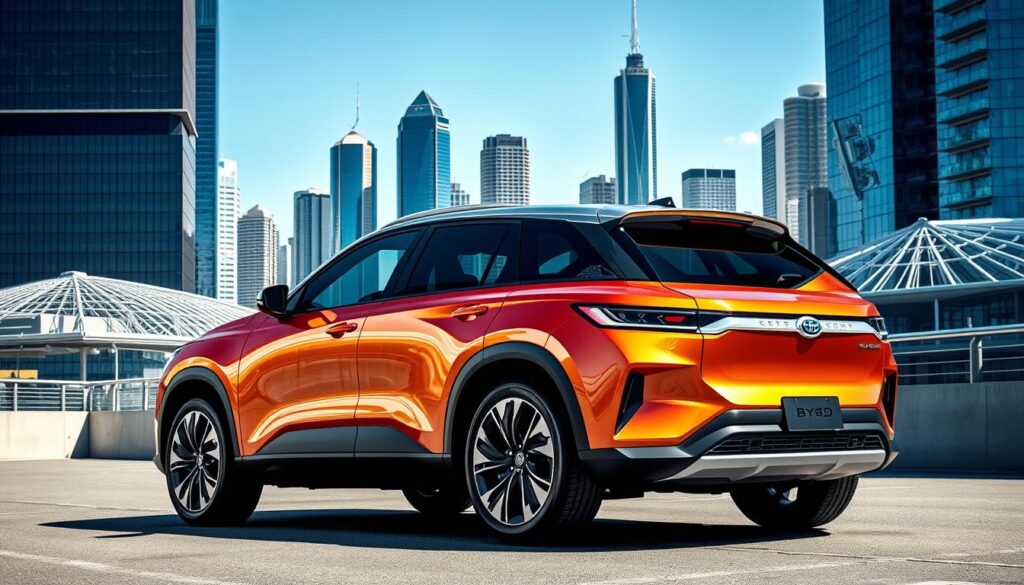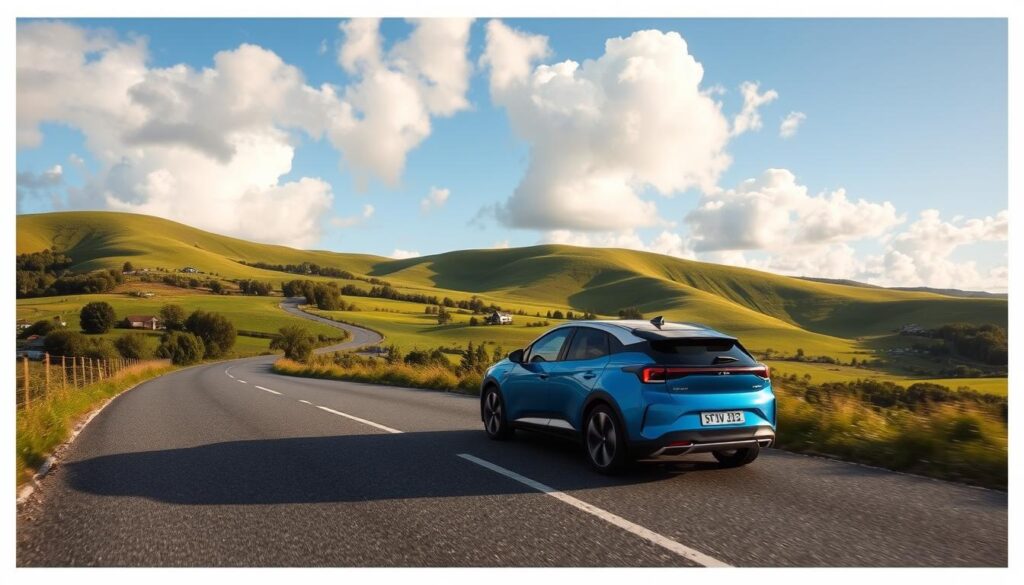
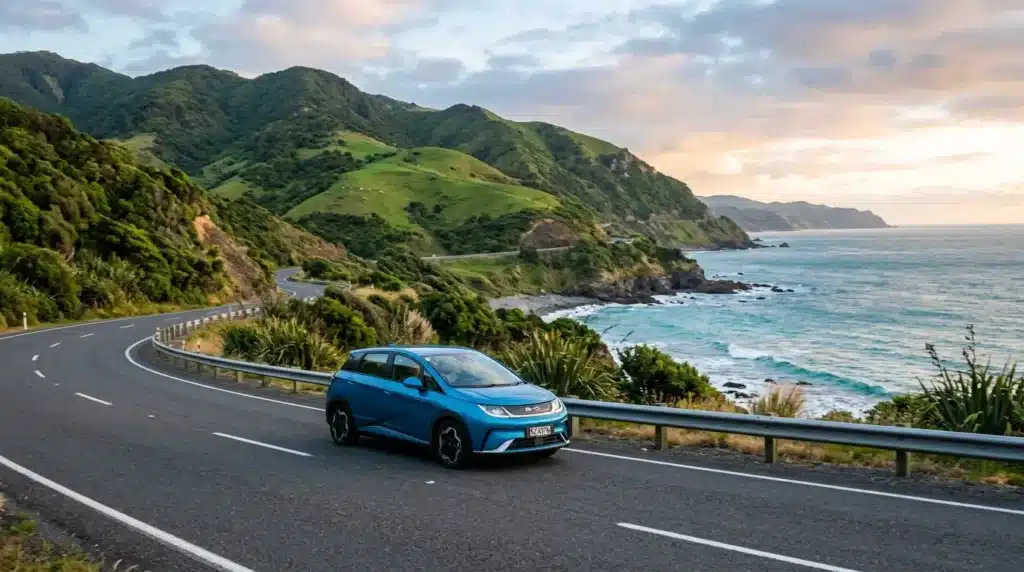
The BYD Dolphin is now one of the most compelling EVs under $45,000 in New Zealand. It offers genuine 340–427km of real-world range, an interior that punches well above its price point, and an 8-year battery warranty that makes the switch from petrol genuinely easier to justify.
But this isn’t a flawless car. There are real compromises — and I want to be honest about them so you can make the right call for your situation.
Here’s my full breakdown of the BYD Dolphin for NZ buyers in 2026: specs, real running costs, what it’s actually like to live with, and who it’s best suited for.
BYD Dolphin NZ Variants, Specs and Pricing in 2026
Two variants are sold in New Zealand: the Standard and the Extended Range. The differences are meaningful — this isn’t a minor battery upgrade.
| Spec | Standard | Extended Range |
|---|---|---|
| Battery capacity | 44.9 kWh | 60.4 kWh |
| WLTP range | 340 km | 427 km |
| Motor output | 70 kW (94 hp) | 130 kW (175 hp) |
| 0–100 km/h | 12.3 sec | 7.0 sec |
| AC charging (max) | 7 kW (Type 2) | 7 kW (Type 2) |
| DC fast charging (max) | 60 kW | 60 kW |
| NZ driveaway price | ~$39,990 | ~$43,990 |
| Battery warranty | 8 yr / 160,000 km | 8 yr / 160,000 km |
My take: Most Kiwi households are well-served by the Standard. If you regularly drive 200 km+ in a single day — Auckland to Taupo, or Wellington to Masterton and back — the Extended Range removes that range anxiety. For typical NZ commuting and weekend use, the Standard covers daily needs with meaningful headroom.
Both variants share the same exterior, interior, and equipment list. The only differences are the battery, motor, and range.
Real-World Range — What Kiwi Drivers Actually Get
WLTP figures are test-track numbers measured in controlled conditions. What you’ll actually see on NZ roads depends on where and how you drive.
In typical NZ use:
- Urban commuting (Auckland, Wellington, Christchurch): expect 90–100% of WLTP — the Dolphin is very efficient in stop-start traffic thanks to strong regenerative braking
- Open highway at 100 km/h: expect 280–310 km from the Standard, 355–385 km from the Extended
- South Island winter driving: subtract 10–20% from highway figures in cold temperatures
- Hilly terrain (Wellington, Dunedin, Queenstown routes): the range penalty is smaller than you might expect — regenerative braking recovers well on descents
The Standard Range Dolphin is viable for most NZ households that have home charging. If your longest regular single-day trip is under 250 km and you can plug in overnight, you won’t have range issues.
The Extended Range earns its premium for drivers based outside main centres, those doing frequent inter-city runs, or buyers who simply want the comfort of extra buffer. Auckland–Hamilton–Tauranga is achievable on a Standard with a brief top-up. Auckland–Wellington is a two-stop trip regardless of variant — plan accordingly.
What Is the BYD Dolphin Like to Drive Day-to-Day?
Pull back from the specs and this is where the Dolphin genuinely surprises people.
Interior quality is better than the price suggests. BYD’s rotating 12.8-inch central display — you can physically pivot it between portrait and landscape — is a distinctive feature that actually works well in practice. The screen is sharp, responsive, and the interface is clean. Seat comfort is good for a small hatchback, and the rear cabin is reasonable for two adults or young children, though tall passengers will find it tighter than a Toyota Corolla.
Ride comfort is the car’s strongest point. BYD’s suspension tuning is well-matched to NZ roads — it absorbs urban bumps and motorway joints without the harsh edge that some EVs have on poorly surfaced roads. NVH (noise, vibration, harshness) is impressively low at highway speeds.
Where the Standard variant feels limited is acceleration. At 12.3 seconds to 100 km/h, it’s noticeably slow — you feel it when merging onto Auckland motorways or overtaking on a two-lane road. It’s not dangerous, but it requires planning. The Extended Range’s 7.0-second 0–100 time transforms the driving character entirely — it’s confident, responsive, and genuinely fun in a way the Standard isn’t.
Boot space is 345 litres — roughly equivalent to a Toyota Yaris Cross. There’s no frunk (front boot). The Dolphin’s practical limit is two adults’ luggage for a weekend trip. For families with strollers or sports gear, it’s workable but not spacious.
Build quality is solid throughout. Panel gaps are tight, the switchgear has a considered, premium feel, and BYD’s Blade Battery construction — where battery cells form part of the chassis structure — makes the Dolphin noticeably stiff and planted compared to older hatchbacks.
How Much Does It Actually Cost to Charge and Run in NZ?
This is where the Dolphin earns serious credibility against petrol alternatives. Running costs are genuinely low.
Quick reference figures:
- Home charging (off-peak, ~$0.28/kWh): ~$12.55 to fill the Standard, ~$16.90 to fill the Extended
- Cost per 100 km (home charging): approximately $2.80–$3.20 — compared to $13–$16 for a petrol hatchback at current NZ fuel prices
- Annual fuel saving vs 13,000 km in a petrol car: $1,300–$1,900 per year depending on your petrol spend and electricity rate
Use the calculator below to estimate your specific costs and savings:
BYD Dolphin NZ Charging Cost Calculator
Other ownership costs to factor in:
- Road User Charges (RUC): Light EVs are currently exempt from RUC in NZ — check NZTA for the current status as this policy is subject to change
- Annual servicing: No oil changes or spark plugs. Budget $200–$350/year for a standard BYD check-up
- Insurance: Expect $850–$1,400/year depending on your record, insurer, and region — broadly similar to a Toyota Corolla
- Tyres: The Standard’s 1,405 kg kerb weight is relatively light for an EV, meaning standard replacement intervals
How the BYD Dolphin Stacks Up Against NZ Rivals
The Dolphin’s main competitors in NZ are the MG4 EV, the Nissan Leaf, and BYD’s own Seal for buyers wanting to step up.
BYD Dolphin vs NZ EV Rivals — Quick Comparison
Prices are approximate NZ driveaway 2026. WLTP range figures. Specs from manufacturer data.
The key takeaway from this comparison: The Dolphin Extended Range sits in a genuinely strong position. It out-ranges the MG4 Standard by 77 km, has a notably better interior, and costs only $4,000 more. The MG4 is a legitimate budget alternative, but the Dolphin’s quality edge is obvious in person.
The Nissan Leaf is hard to recommend at $49,990 in 2026. You’re paying a premium for less range and an ageing platform. It made sense before newer Chinese EVs arrived in NZ — that window has closed.
The BYD Seal is the natural step up if you want a full sedan, sport-car acceleration, and 500+ km of range. But at $52,990, you’re in different territory — and the decision changes.
Who Should Actually Buy the BYD Dolphin in NZ?
The Standard is the right choice if:
- You drive under 180 km/day and have home charging set up
- You primarily use it for urban commuting in Auckland, Wellington, or Christchurch
- Minimising upfront cost is your priority
The Extended Range is the right choice if:
- You regularly drive inter-city routes (Auckland–Hamilton, Wellington–Palmerston North and back)
- You want genuinely responsive performance — the driving character is night-and-day different
- You’re based outside a main city and want the extra buffer between public chargers
The Dolphin is not the right car if:
- You rely entirely on public DC fast charging with no home setup — the 60kW maximum charge rate is slower than most competitors at this price, making public top-ups longer than ideal
- You need to tow — neither variant has a tow rating
- You regularly carry 4–5 tall adults — rear legroom is tight
- You do regular South Island alpine driving in winter — account for 15–20% range reduction carefully before committing
My recommendation for most NZ buyers: The BYD Dolphin Extended Range at ~$43,990 is the best-value EV under $50,000 in NZ right now. The $4,000 premium over the Standard buys you 87 km of additional range and cuts the 0–100 time from 12.3 to 7.0 seconds. On NZ roads, both those differences matter daily.
The 8-year, 160,000 km battery warranty is a serious commitment from BYD — and it removes the biggest long-term uncertainty of EV ownership. That alone shifts the value proposition significantly compared to alternatives without equivalent coverage.