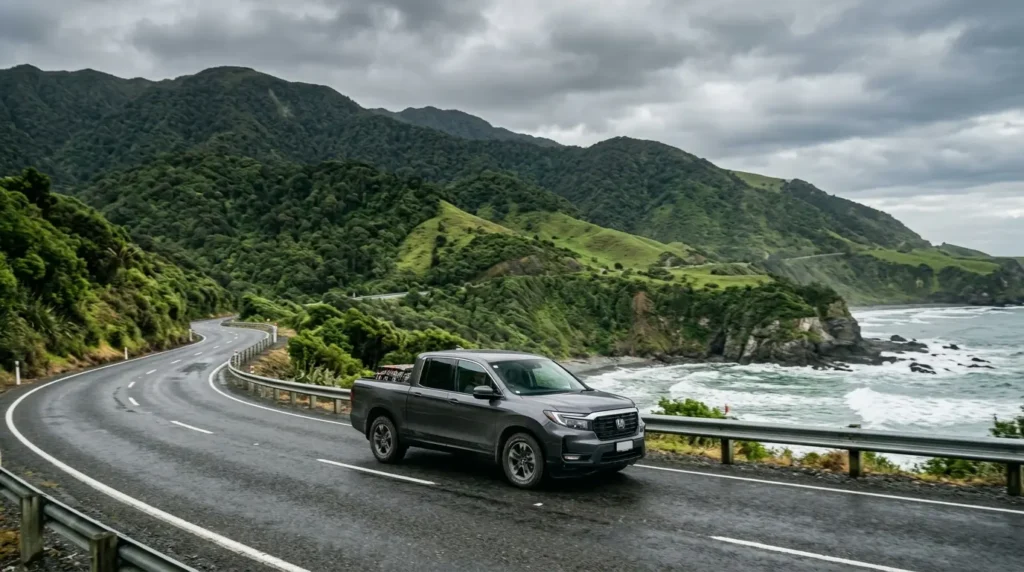
The Honda Ridgeline keeps showing up in NZ search results. It’s a pickup truck that Honda builds almost exclusively for North America — never sold new here, never offered in right-hand drive, and rarely seen on our roads. So why are Kiwi drivers searching for it?
Because on paper, it’s genuinely interesting. Unibody construction, permanent AWD, a lockable in-bed trunk, and a ride quality that makes most traditional utes feel agricultural by comparison. If those things appeal to you, I understand the curiosity.
But before you start browsing US auction sites or calling freight forwarders, you need to understand what getting a Ridgeline to NZ actually involves. This guide covers the real specs, the actual import numbers, how it stacks up against what you can buy locally, and whether it makes practical sense for a Kiwi driver.
What Makes the Honda Ridgeline Different from Every Other Ute
Most dual-cab utes in NZ — the HiLux, Ranger, Navara, Triton — are body-on-frame vehicles. Think of them as trucks at heart: heavy, durable, and built around commercial capability.
The Ridgeline is fundamentally different. It uses a unibody platform shared with the Honda Pilot SUV. That means it’s built more like a large car than a traditional truck. On sealed roads, this shows up immediately as noticeably better ride quality, sharper handling, and a quieter cabin.
What the unibody design gives you:
- Significantly better on-road ride comfort — roads that rattle a HiLux are no issue for a Ridgeline
- Sharper, more predictable handling and a lower centre of gravity
- A lockable In-Bed Trunk — a full waterproof storage compartment under the cargo floor, with its own drain plug
- A dual-action tailgate that opens both down and sideways — useful for longer loads
- A more refined interior that feels closer to a luxury SUV than a workhorse ute
What you give up:
- Towing capacity: Ridgeline tops out at 2,268 kg versus 3,500 kg for a HiLux or Ranger
- No 4WD low range — just permanent AWD, which limits serious off-road and farm work
- No diesel option — V6 petrol only, with matching fuel costs
- Zero NZ dealer support, parts availability, or WoF history
For a driver who spends the vast majority of their time on paved roads and wants a capable, comfortable daily-driver with a cargo bed, the Ridgeline concept makes real sense. For tradies, farmers, or anyone needing genuine towing or off-road capability, it falls short.
2026 Honda Ridgeline Specs: What You’re Actually Getting
The 2026 Ridgeline runs Honda’s proven 3.5L i-VTEC V6 producing 209 kW (280 hp) and 355 Nm of torque, paired with a 9-speed automatic transmission. AWD is standard across every variant — there’s no 2WD option.
| Specification | Honda Ridgeline 2026 |
|---|---|
| Engine | 3.5L V6 petrol (i-VTEC) |
| Power | 209 kW (280 hp) |
| Torque | 355 Nm |
| Transmission | 9-speed automatic |
| Drive | Permanent AWD |
| Towing capacity | 2,268 kg |
| Payload | 720 kg |
| Fuel economy (est. NZ real-world) | 11.5–13.5L/100km |
| Cargo bed length | 1.52 m |
| Ground clearance | 203 mm |
| Wheelbase | 3,098 mm |
| Gross vehicle mass | 2,586 kg |
The 2026 lineup in the US runs from Sport through RTL, RTL-E, Black Edition, and TrailSport. The TrailSport is the most interesting for NZ buyers — it adds all-terrain tyres, underbody skid plates, and off-road suspension tuning. It’s the closest the Ridgeline gets to matching a genuine 4WD ute.
One thing that surprises most people: the Ridgeline’s wheelbase is 3,098 mm — larger than a HiLux double cab (3,085 mm). It’s a physically big vehicle, which matters for parking in NZ town centres.
Honda Ridgeline NZ Pricing: What Importing Actually Costs
Here’s where the conversation gets complicated. The Ridgeline is a left-hand drive (LHD) vehicle. All US-market units have the driver on the left. New Zealand is a right-hand drive country, and NZTA treats LHD imports differently from standard Japanese used vehicles.
Importing an LHD vehicle is legal in NZ, but you’ll need to apply for a specialist or low volume vehicle exemption from NZTA. This adds time, additional compliance inspections, and real cost. Once registered, the LHD driving position noticeably affects visibility when overtaking — a meaningful safety consideration on NZ’s two-lane rural roads.
Beyond that complication, here’s the realistic cost breakdown:
| Cost Component | Estimated Range (NZD) |
|---|---|
| US purchase price (used 2022–2024) | $55,000 – $90,000 |
| International shipping (US to NZ) | $4,500 – $7,000 |
| NZ Customs duty | $0 (NZ–US free trade) |
| GST (15% on CIF value) | $9,000 – $15,000 |
| MPI biosecurity inspection | $400 – $600 |
| NZTA compliance + LHD exemption | $1,500 – $3,500 |
| WoF + registration | $250 – $400 |
| Total landed estimate | $70,000 – $116,500 |
For reference: a new 2026 Ridgeline Sport starts at around USD $42,900 (~NZD $72,500) before it leaves the US. Add shipping, GST, and compliance and you’re looking at NZD $90,000–$95,000 all-in for a brand-new unit.
Use the calculator below to estimate your specific import cost:
Honda Ridgeline NZ Import Cost Estimator
Estimates only. Exchange rate, GST treatment, and compliance costs vary. Consult a licensed customs broker for accurate figures.
Honda Ridgeline vs NZ’s Best Dual-Cab Utes
If you’re weighing up the Ridgeline against what’s available through NZ dealers, here’s the honest side-by-side:
Ridgeline vs NZ Dual-Cab Utes: Quick Comparison
The numbers tell a clear story. The Ridgeline’s only genuine advantage over these locally-sold alternatives is ride quality. For that, you pay a significant price premium, accept LHD driving, and give up towing capacity, parts support, and easy resale.
Running Costs for a Honda Ridgeline in NZ: What to Budget
The 3.5L V6 petrol engine is the most significant ongoing cost. NZ petrol prices typically sit at $2.60–$3.10 per litre for 91 octane. At 12L/100km real-world consumption, annual fuel costs for 20,000 km of driving are roughly $6,240–$7,440 per year.
Compare that to a diesel HiLux (8.5–10L/100km at ~$2.05/litre for diesel): approximately $3,485–$4,100 per year. The difference is $2,500–$3,500 in fuel costs annually — for the same kilometres.
Use the calculator below to model your specific situation:
Annual Fuel Cost Comparison
Based on estimated real-world consumption figures. Actual costs vary with driving style and conditions.
Parts and servicing are the other ongoing cost concern. Honda NZ dealers have no Ridgeline parts inventory — everything model-specific must be sourced from the US or Australia, with 1–3 week lead times and freight costs on top. Routine servicing (oil, filters, tyres) is fine at any workshop, but anything beyond that becomes a sourcing exercise.
Should You Import a Honda Ridgeline to NZ?
For most NZ buyers, my honest answer is no.
The LHD reality is the primary issue. Overtaking on NZ’s single-lane rural roads is genuinely more difficult from the left-hand side — and for a vehicle this size, that matters. Resale is also limited, since you’ll be selling to a narrow pool of buyers willing to navigate the same compliance hurdles you did. And when you factor in the $70,000–$115,000 landed cost, there are compelling locally-supported alternatives at every price point.
The Ridgeline makes sense for you if:
- You spend 90%+ of your time on sealed urban or suburban roads
- You never need to tow more than 2,000 kg or do serious off-road work
- You genuinely value the In-Bed Trunk, superior ride quality, and SUV-like cabin
- You’re comfortable sourcing parts internationally and managing LHD practicalities
Consider a local alternative if:
- You tow boats, horse floats, trailers, or farm equipment
- You work on gravel, farm tracks, or genuinely rough terrain
- You want a vehicle with strong NZ resale value
- You want dealer support and parts on the shelf
If the Ridgeline’s concept appeals — a comfortable, capable daily driver with a cargo bed — I’d suggest looking hard at the Ford Ranger Wildtrak (excellent ride quality for a body-on-frame ute, sold new in NZ from ~$71,990) or the Isuzu D-Max (exceptional reliability, 3,500 kg towing, strong NZ dealer network). Both give you real-world practicality without the complexity of an LHD import.
The Ridgeline is a clever truck. In North America, it genuinely earns its place. In New Zealand, the compromises stack up in a way that’s hard to justify for most buyers.