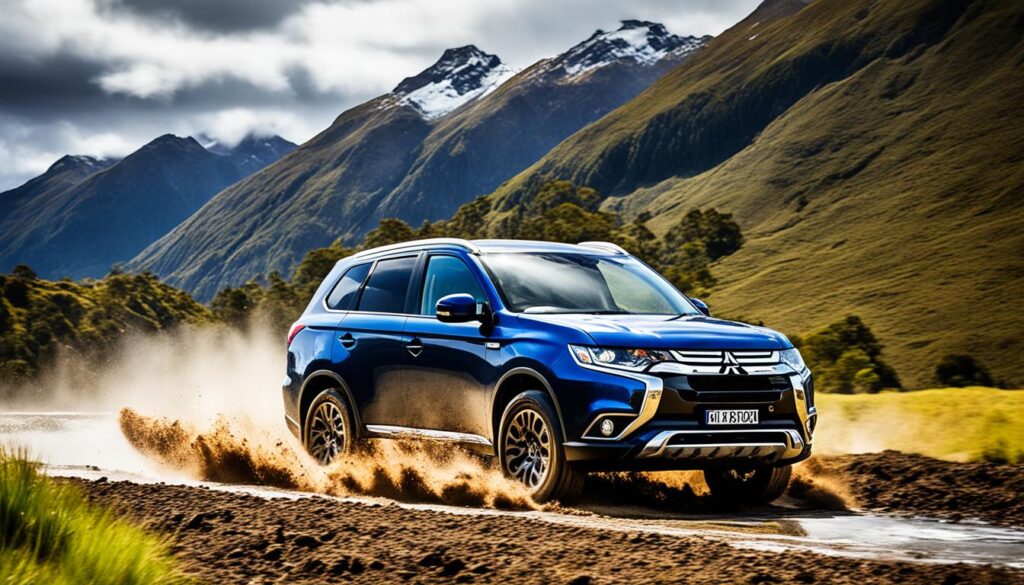
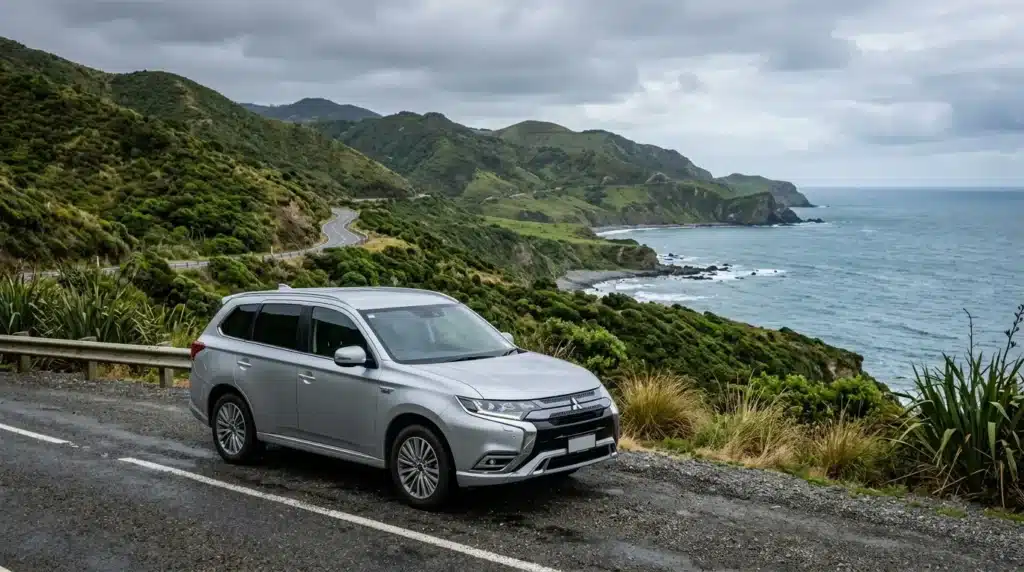
The Mitsubishi Outlander PHEV has been NZ’s best-selling plug-in hybrid SUV for years. It’s easy to see why — a genuine 7-seater, real AWD, and the ability to handle most daily commutes on electricity alone.
But it’s not the only option anymore. The Toyota RAV4 Hybrid, Honda CR-V e:PHEV, and a growing field of EVs are all competing for the same dollar. Whether the Outlander PHEV is the right buy for you depends on how you actually drive.
I’ve broken down every variant, the real running costs in NZ conditions, and how it stacks up against the competition — so you can make this decision with confidence.
Mitsubishi Outlander PHEV Variants and NZ Prices in 2026
The Outlander PHEV is available in four main variants in NZ. All use the same core PHEV powertrain — the differences come down to features, seating, and price.
| Variant | Seats | Drive | Est. NZ Price (on-road) |
|---|---|---|---|
| GX Premium | 5 | AWD | From $58,990 |
| GX Premium 7-seat | 7 | AWD | From $62,990 |
| GSR | 5 | AWD | From $67,990 |
| GSR 7-seat | 7 | AWD | From $71,990 |
The GX Premium is the entry point and genuinely well-equipped — heated seats, 20-inch alloys, a 12.3-inch touchscreen, and the full PHEV drivetrain. You’re not giving up much by skipping the GSR.
The GSR adds Bose audio, a heads-up display, a power tailgate, and a larger panoramic sunroof. Nice features, but the $9,000 step-up is hard to justify unless those specific items matter to you.
If you need seven seats, the jump from 5 to 7-seat config is around $4,000 — reasonable if you actually use the third row. Be realistic: those rear seats are tight for adults on longer trips.
How Far Does the Outlander PHEV Actually Go on Electric in NZ?
The current-gen Outlander PHEV uses a 20 kWh battery with a WLTP-rated EV range of 84 km. In practice, that number changes significantly depending on conditions.
Real-world range in NZ:
- Summer, flat commuting (Auckland/Wellington CBD): 65–75 km
- Mixed use with hills (like Wellington or Dunedin): 50–60 km
- Highway driving at 100 km/h: 40–50 km
- Winter, with heating on: 45–55 km
The key insight: if your daily commute is under 50 km and you charge overnight at home, you’ll barely touch the petrol engine during the week. That’s the scenario where the Outlander PHEV makes the most financial sense.
The twin-motor S-AWC system (electric front motor + electric rear motor) means you get genuine AWD off-road performance even in EV mode — something a standard hybrid like the RAV4 Hybrid can’t fully replicate.
Outlander PHEV Real-World Range by Condition
Real-world estimates based on NZ driving conditions. WLTP figure is manufacturer-rated.
What Does the Outlander PHEV Cost to Run in NZ Each Year?
This is where PHEVs get complicated — and where most buyers get caught out. Your annual running costs depend almost entirely on how often you charge.
A home-charged Outlander PHEV covering 15,000 km/year with 80% electric driving costs roughly:
- Electricity: ~$420/year (at $0.30/kWh home charging)
- Petrol: ~$600/year (for the remaining 3,000 km @ $2.40/L, ~8L/100km in petrol mode)
- Total fuel cost: ~$1,020/year
The same driver who never charges — running it as a standard petrol SUV — would spend approximately $3,600/year in fuel alone. That’s the difference between a smart PHEV purchase and an expensive petrol car with a heavy battery.
Use the calculator below to estimate your actual annual fuel cost based on your real driving pattern:
Outlander PHEV Annual Running Cost Estimator
Estimates only. Actual costs vary by driving style, terrain, and charging habits.
Outlander PHEV vs Toyota RAV4 Hybrid vs Honda CR-V e:PHEV: Which Wins for Kiwis?
Three SUVs dominate the NZ PHEV and hybrid conversation. Here’s where each one lands:
| Outlander PHEV GSR | Toyota RAV4 Hybrid GX | Honda CR-V e:PHEV | |
|---|---|---|---|
| Drive type | PHEV (plug-in) | Self-charging hybrid | PHEV (plug-in) |
| EV range (WLTP) | 84 km | N/A | ~80 km |
| AWD type | Twin-motor S-AWC | E-Four electric rear | Twin-motor (FWD-biased) |
| 7-seat option | Yes | Yes | No (5-seat only) |
| Towing capacity | 1,500 kg | 1,500 kg | 750 kg |
| Est. NZ price | ~$68–72k | ~$58–70k | ~$62–68k |
| Boot space (5-seat) | 477 L | 487 L | 414 L |
My take: The RAV4 Hybrid undercuts the Outlander on price and is more fuel-efficient in its self-charging mode — but you can’t plug it in, so your fuel costs are always higher than a charged PHEV. If you’ll charge consistently, the Outlander wins on running costs by a clear margin.
The CR-V e:PHEV has a similar EV range but no 7-seat option and a lower towing limit. If towing a boat or trailer matters, the Outlander is the clear winner.
Buy the Outlander PHEV if: You need 7 seats, plan to charge regularly, and tow occasionally.
Buy the RAV4 Hybrid if: You want lower purchase price and don’t want to manage charging.
Buy the CR-V e:PHEV if: You prefer a more refined, car-like driving experience and don’t need towing.
Outlander PHEV Towing, Ground Clearance, and Life on NZ Roads
The Outlander PHEV’s real-world advantage over most hybrid competitors is its capability on varied terrain. NZ roads aren’t always smooth, and a lot of Kiwi buyers tow.
Towing: The Outlander PHEV is rated for 1,500 kg braked towing across all variants. That covers most small boats, trailers, and lifestyle trailers. It’s not a ute replacement, but it handles weekend and holiday towing comfortably.
Ground clearance: 192 mm across all variants. Not lifted like a Forester, but capable on gravel roads and light off-road. The S-AWC system gives you genuine AWD traction — useful on coastal roads, farms, and in wet NZ winters.
Daily driveability: The Outlander PHEV drives more like a smooth electric vehicle than a traditional petrol SUV. In EV mode, acceleration is effortless and quiet. The petrol engine kicks in at higher speeds or when the battery runs low, and it’s reasonably smooth — but you’ll notice the transition if you’re listening for it.
Charging at home: A standard 10-amp household outlet will charge from near-empty in around 8 hours overnight. If you install a dedicated home EV charger (7.2 kW), you’re looking at roughly 2.5–3 hours. For most daily users, overnight charging on a standard outlet is completely adequate.
Where the Outlander PHEV Falls Short
No vehicle is without compromise, and I think it’s important to be direct about where this one struggles.
The interior feels a step behind European competitors. The touchscreen and infotainment system work fine, but the layout and materials quality aren’t quite at the level of a Volkswagen Tiguan or a Volvo XC40. It’s a functional, practical interior — not a premium one.
Third-row seating is genuinely tight. The 7-seat version is useful for occasional family overflow, but the rearmost seats are best suited to children or short adults on short trips. Don’t buy the 7-seater expecting to comfortably transport three adults.
Real petrol consumption is high if you don’t charge. Running the Outlander PHEV exclusively on petrol delivers around 8–10 L/100km — worse than the RAV4 Hybrid’s 5–6 L/100km in self-charging hybrid mode. The weight of the battery system is a liability if you’re not using the electric motor.
No over-the-air updates. Unlike Tesla or some newer EVs, the Outlander PHEV doesn’t receive software updates wirelessly. You’ll need to visit a dealer for any system changes. For most owners this isn’t an issue, but it’s worth knowing.
Depreciation is reasonable but not exceptional. The first-gen and second-gen Outlander PHEVs depreciate predictably. The current model holds value well relative to the broader market, but don’t expect EV-tier resale premiums. Budget for 15–20% depreciation in the first three years.