
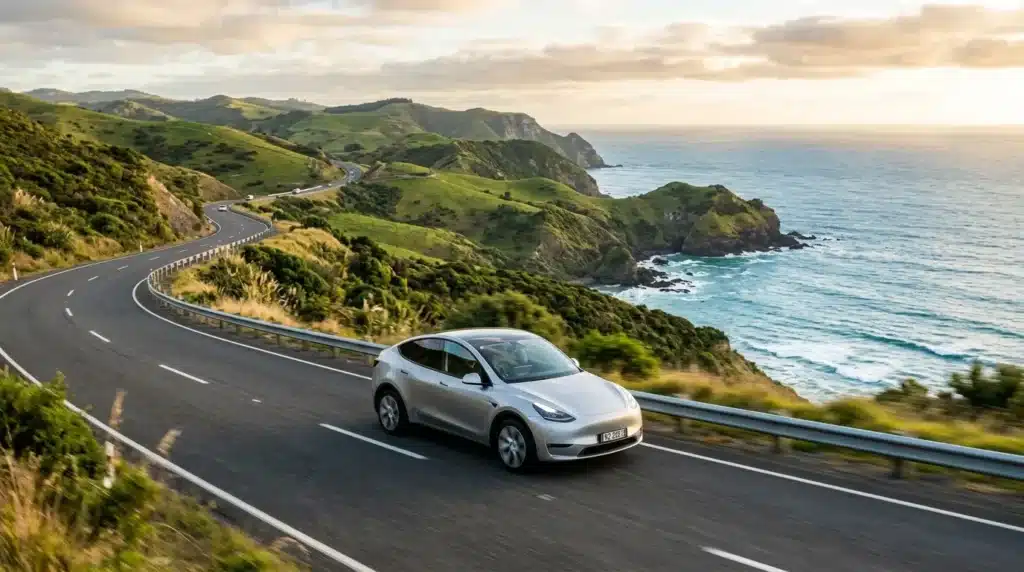
The Tesla Model Y has been NZ’s best-selling electric car for the past two years running. In a market flooded with new EV entrants — BYD, MG, Polestar, Leapmotor — it still sells more than most of its competitors combined. That says something.
The 2025/2026 Juniper refresh brought meaningful changes: a new exterior, a completely redesigned interior, and a rear passenger screen that honestly shifts the quality bar for the whole cabin. If you were on the fence about the Model Y before, the updated version is worth a serious look.
This guide cuts through the marketing spin. Here’s what the Tesla Model Y actually costs in NZ, how far it really goes on a charge, what the Supercharger network looks like for everyday Kiwi driving, and which variant gives you the best value for money.
What Changed in the Tesla Model Y Juniper Refresh
The 2024/2025 Juniper refresh wasn’t just a cosmetic tweak — it addressed several complaints about the original Model Y that had built up over years.
On the outside, the front end got a smoother, more cohesive look. The headlights are thinner and more integrated, and the rear tail light bar now runs the full width of the car. It looks more deliberate than the original, which always had a slightly unfinished quality to the fascia.
The interior is where the bigger changes landed. The centre console is completely new, with a wider floating design and ambient lighting throughout the cabin. Front seats gained 8-way power adjustment (previously the base variant only had manual lumbar). The biggest addition is a 9-inch rear entertainment screen mounted to the back of the centre console — genuinely useful for families on road trips.
Build quality improved noticeably. Panel gaps are tighter, the door seals feel more substantial, and the steering wheel no longer has the slightly hollow feel of the pre-refresh car.
One thing that didn’t change: the Autopilot hardware and software stack. You’re still buying into the same driver assistance system, which is excellent on motorways and still limited on complex urban intersections.
Tesla Model Y NZ Pricing 2026: Which Variant Is Worth the Money?
Tesla sells three variants of the Model Y in NZ. Here’s the breakdown:
| Variant | Drive | Price (NZ$) | WLTP Range | 0–100 km/h |
|---|---|---|---|---|
| Model Y RWD | Rear-wheel | $67,990 | 507 km | 6.9 sec |
| Model Y Long Range AWD | All-wheel | $82,990 | 533 km | 5.0 sec |
| Model Y Performance AWD | All-wheel | $97,990 | 514 km | 3.7 sec |
Prices as of early 2026 — check Tesla’s NZ website for current pricing as they adjust regularly.
The RWD variant is the sweet spot for most buyers. You get over 500km of WLTP range, the full new interior, and a price point that’s competitive with similarly specced ICE SUVs once you factor in fuel savings. The rear-wheel-drive setup is perfectly capable on sealed NZ roads.
The Long Range AWD adds real-world value if you regularly drive in wet South Island conditions, need genuine towing capacity (up to 1,600kg braked), or want meaningful all-weather security. The extra $15k is harder to justify on the basis of range alone — the difference in real-world terms is modest.
The Performance variant is for drivers who want genuine sports car acceleration in an SUV body. It’s fast. But the $97k price puts it in a territory where it competes against cars with very different personalities. For most NZ buyers, it’s hard to justify purely on practicality.
How Far Does the Tesla Model Y Actually Go in NZ?
WLTP range figures are measured under idealised European test conditions. Real-world NZ driving reduces them — often significantly.
What to realistically expect:
- RWD at motorway speeds (100 km/h): 380–410 km
- RWD in mixed urban/motorway driving: 410–450 km
- Long Range AWD at motorway speeds: 400–430 km
- Winter (0–10°C with heater on): subtract 15–20% from the above
For most NZ driving patterns — Auckland commuting, weekend trips, regional runs — the RWD’s real-world range is more than enough. You’re unlikely to need a charge more than once on a trip from Auckland to Wellington with the Supercharger in Taupo or Palmerston North.
Where it gets tighter: South Island touring. If you’re doing the Christchurch–Queenstown run in winter, range anxiety is real on the RWD. The Long Range AWD gives you meaningful headroom here.
A useful rule of thumb: don’t plan to use more than 80% of the battery between charges. That sweet spot preserves battery health and keeps charge speeds high.
Tesla Supercharger Network in NZ: Is It Good Enough?
This is one of Tesla’s strongest selling points in NZ — and it matters a lot for a country that’s geographically stretched.
Key Supercharger locations as of 2026:
- Auckland (multiple sites: Albany, Takapuna, Manukau, Sylvia Park)
- Hamilton
- Tauranga
- Rotorua
- Taupo
- Palmerston North
- Wellington (Petone, Thorndon)
- Nelson
- Christchurch (multiple sites)
- Queenstown
- Dunedin
The North Island main highway corridor (Auckland–Wellington via SH1) is well-covered. The South Island has good coverage on the major tourist routes, though some rural stretches require planning.
Non-Tesla charging: The Model Y supports CCS2 (Type 2 AC and CCS DC), so you can use ChargeNet, Z Energy, and other public networks. Speeds vary — you won’t hit Supercharger speeds on most third-party DC chargers, but they work in a pinch.
Home charging: If you have a garage, fit a Tesla Wall Connector or a compatible 7.4kW AC charger. You’ll add roughly 50km of range per hour of charge. Plugging in overnight covers most daily driving needs easily. This is where EV economics really work — if you never need to use a public charger for daily driving, your cost per kilometre drops dramatically.
What Does a Tesla Model Y Actually Cost to Run in NZ?
Tesla Model Y vs Petrol SUV: Annual Running Cost Comparison
Enter your driving habits to see how costs stack up
Running cost calculator — NZ figures, 2026. Results are indicative estimates only.
Key running cost figures to know:
- Electricity cost per 100km: ~$5.10 (at $0.30/kWh, 17kWh/100km)
- Road User Charges (RUC): $76 per 1,000km — mandatory for all EVs in NZ since 2024
- Annual servicing: Tesla recommends cabin air filter replacement and brake fluid check every 2 years. Budget around $250–$400/year, significantly less than a comparable ICE SUV
- Tyre costs: Model Y tyres are 20″ and not the cheapest to replace. Budget $250–$350 per tyre for quality rubber
At 15,000km/year, most Model Y owners find they save $1,000–$2,000 annually on fuel and servicing compared to a petrol equivalent — even after paying RUC. Use the calculator above with your own numbers.
Autopilot and Driver Assistance: What You Actually Get
All Model Y variants in NZ come with Tesla Autopilot as standard. This includes:
- Traffic-aware cruise control
- Autosteer (lane-centring on motorways and divided highways)
- Auto lane change (with confirmation)
- Autopark
Enhanced Autopilot ($5,800 NZD) adds Navigate on Autopilot (motorway on/off ramps, interchanges), Autopark, and Summon.
Full Self-Driving (FSD, currently ~$11,900 NZD) enables the camera-based FSD system. In NZ, this is still supervised — you must remain attentive and ready to take control.
For most Kiwi drivers, standard Autopilot is the only one that delivers meaningful daily value. On the Auckland motorway network or the Desert Road stretch of SH1, adaptive cruise with lane-keeping is genuinely stress-reducing on long drives.
FSD is worth considering if Tesla’s autonomous driving capability improves significantly in NZ conditions over the next 12–24 months. Right now, it struggles with some of our less-consistently-marked rural roads.
Tesla Model Y NZ 2026: Honest Pros and Cons
What it does well:
- Best-in-class software and over-the-air updates — the car genuinely gets better over time with firmware updates
- Supercharger network is the most reliable fast-charge experience available in NZ
- Cabin space and practicality — the flat floor (no transmission tunnel), large frunk, and 854L boot make it one of the most practical EVs at this size
- Resale value — Tesla holds value reasonably well in NZ; demand for used Model Ys is strong
- Operating costs — once you factor in fuel and servicing, total cost of ownership is competitive over 5+ years
Where it falls short:
- Build quality inconsistencies — the Juniper refresh improved things meaningfully, but panel gaps and interior fit remain variable between individual cars. Inspect yours carefully at handover
- No CarPlay or Android Auto — Tesla’s own infotainment is capable but if you’re committed to Apple or Google’s ecosystem, this is a genuine limitation
- Rear visibility — the sloped roofline creates a large blind spot. The reversing camera helps, but it’s noticeably worse than a more upright SUV
- Tyre noise — at NZ motorway speeds, road noise in the cabin is louder than competitors like the BYD Atto 3 or Hyundai Ioniq 5
- No physical controls for many functions — climate, mirrors, and steering column adjustment all live in the touchscreen. Some drivers find this genuinely frustrating
Who should buy the Tesla Model Y:
- Regular commuters who can charge at home overnight
- Families wanting a practical, tech-forward EV with genuine cargo space
- Drivers who do regular North Island or South Island touring and want Supercharger access
- Buyers who want the most established software ecosystem in any EV
Who should look elsewhere:
- Buyers who prioritise traditional interior quality and materials (the Hyundai Ioniq 5 or Kia EV6 have a more premium feel)
- Those who need CarPlay or Android Auto integration
- Rural drivers far from Supercharger coverage who would rely on third-party charging infrastructure