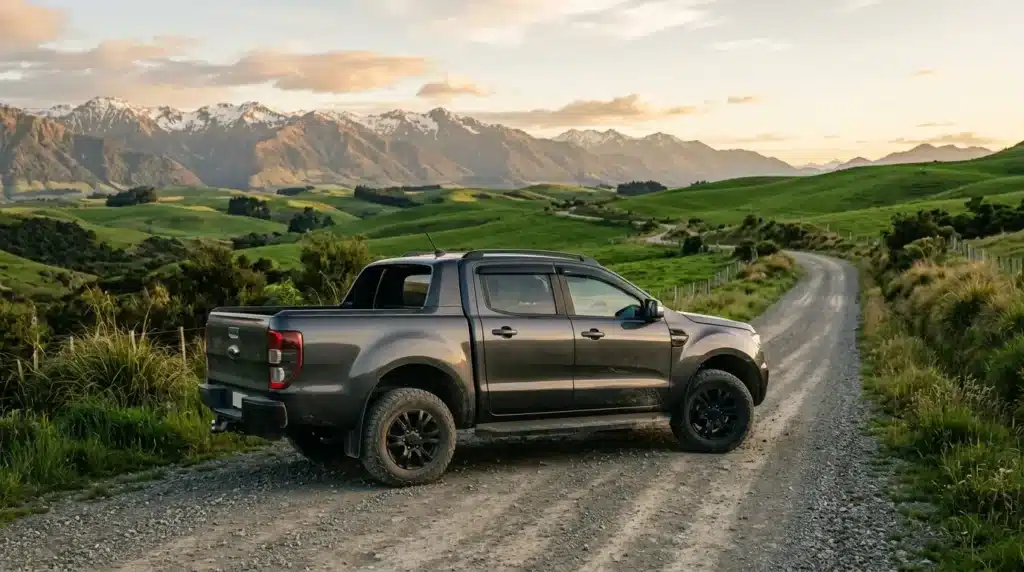
The Ford Ranger has been the best-selling vehicle in New Zealand for three consecutive years. Not just the best-selling ute — the best-selling vehicle, full stop. In a country where lifestyle and practicality collide on a daily basis, the Ranger has positioned itself as the default choice for tradies, farm workers, families, and weekend adventurers alike.
But choosing a Ranger isn’t as simple as walking into a dealership and picking one. There are six main variants, three engine options, and a price range that spans nearly $50,000 from base to top. Getting this decision wrong costs you either capability you needed or money you didn’t need to spend.
I’ve broken down every variant, engine, running cost, and capability figure so you can make this decision clearly. Here’s everything you need to know about the Ford Ranger in New Zealand for 2026.
Why the Ranger Has Become NZ’s Default Ute
It wasn’t always this way. For decades, the Toyota Hilux was the undisputed king of NZ utes, with a reputation built on bulletproof reliability. The Ranger changed that equation with its next-generation platform — bringing a genuinely car-like interior, advanced technology, and a refined driving experience without sacrificing the capability that NZ buyers demand.
The result is a ute that works on a Southland sheep station on Friday and feels comfortable on Auckland’s motorways on Monday. That versatility is what no other ute has been able to match at this price point.
NZ’s terrain also plays to the Ranger’s strengths. From Coromandel beach tracks to Central Otago farm roads, the Ranger’s ground clearance, wading depth, and four-wheel drive system handle real NZ conditions well. The fact that it tows 3,500kg puts it within reach of the vast majority of trailer, caravan, and boat combinations you’ll encounter on NZ roads — and that’s a practical advantage most buyers underestimate until they need it.
Ford Ranger Variants and Prices in NZ (2026)
The Ranger lineup runs from a workhorse base spec to a full-blown performance truck. Here’s the complete picture:
| Variant | Price (incl. GST) | Engine | Cab | Key Highlights |
|---|---|---|---|---|
| XL | From $52,990 | 2.0L single-turbo diesel | Super Cab | Steel wheels, basic interior, 4×4 available |
| XLS | From $57,990 | 2.0L bi-turbo diesel | Super/Double cab | Alloys, reverse camera, keyless entry, cruise control |
| XLT | From $63,990 | 2.0L bi-turbo diesel | Double cab | 12″ SYNC4, heated seats, leather steering wheel, LED headlights |
| Sport | From $69,990 | 2.0L bi-turbo diesel | Double cab | Sport styling pack, 18″ alloys, sport bar, upgraded audio |
| Wildtrak | From $76,990 | 3.0L V6 diesel | Double cab | 360° camera, matrix LED headlights, adaptive cruise, full leather |
| Raptor | From $99,990 | 3.0L V6 diesel | Double cab | Fox 2.5″ shocks, 33″ BF Goodrich tyres, 292kW, performance off-road |
Prices are guide RRP and may vary. Check with your local Ford dealer for current pricing and promotional offers.
The biggest jump in value is between the XLS and XLT — you’re getting the 12-inch SYNC4 touchscreen, heated seats, and a meaningfully upgraded interior for roughly $6,000 more. The step from XLT to Sport is primarily styling; the Sport doesn’t add significant capability. The Wildtrak’s jump to V6 diesel, however, changes the driving experience in a way you’ll notice every day.
My recommendation by buyer type:
- Tradie daily driver: XLS — bi-turbo engine, practical spec, no unnecessary extras to get damaged on site
- Family and lifestyle buyers: XLT — enough technology, a comfortable interior, right price point
- Heavy towing (caravans, large boats): Wildtrak V6 — the extra torque makes a real difference above 2.5 tonnes
- Off-road and adventure: Raptor — if budget allows, nothing else comes close in production trim for serious terrain
What’s Under the Bonnet? Engine Options Compared
Three engines power the Ranger lineup in NZ:
2.0L Single-Turbo Diesel (125kW / 405Nm) — XL only. This is a competent work engine, but the single-turbo setup falls behind on motorway overtaking and when you’re fully loaded. Fine if the Ranger is purely a work vehicle and rarely sees a motorway, but most NZ buyers will feel the gap quickly.
2.0L EcoBlue Bi-Turbo Diesel (170kW / 500Nm) — XLS through Sport. This is the sweet spot for most NZ buyers. The bi-turbo setup delivers 500Nm from low in the rev range, making it capable under load without the fuel penalty of the V6. Real-world economy sits around 8.5–9.5L/100km depending on how loaded you are and how hilly your routes get.
3.0L V6 Turbo Diesel (184kW / 600Nm) — Wildtrak and Raptor. The V6 is a genuinely different machine. It’s smoother, pulls harder at highway speeds, and handles maximum towing with noticeably less effort. If you’re regularly dragging a heavy caravan through Arthur’s Pass or a large boat trailer up the Remutaka Hill, the extra torque budget matters. Fuel economy lands around 9.5–11L/100km under towing conditions.
All three engines run on standard diesel. The bi-turbo and V6 both use 10W-30 oil and follow a 15,000km/12-month service interval — the same schedule, so no complexity there.
Towing and Off-Road Capability — Real Numbers for NZ Conditions
The Ranger’s headline towing figures are 3,500kg (braked) for bi-turbo and V6 variants, and 3,000kg for the single-turbo XL. These numbers cover the full range of what most NZ buyers are pulling — boats up to about 7m, horse floats, large caravans, and heavy farm trailers.
Key capability figures:
- Ground clearance: 228mm standard, 283mm Raptor
- Wading depth: 800mm standard, 850mm Raptor
- Approach angle: 29° standard, 32° Raptor
- Maximum payload: ~1,100kg (bi-turbo double cab)
The standard Ranger’s Trail Control and Terrain Management System gives you dedicated modes for mud, sand, rock, and grass. It works well in real NZ conditions — from soft farm paddocks after rain to technical four-wheel-drive tracks. You don’t need the Raptor to handle most of what NZ throws at you.
The Raptor exists for a different level of use: Fox 2.5″ Live Valve shocks, 33″ all-terrain tyres, and enough suspension travel to take high-speed corrugations and jumps. For 90% of NZ use cases, the standard Ranger covers it comfortably. The Raptor is for buyers who genuinely push hard off-road or who just love what it represents.
Inside the Cabin — Technology and Comfort
This is where the current-generation Ranger separated itself from the Hilux and everything else in the segment. The interior is genuinely good by modern SUV standards — not just “good for a ute.”
The 12-inch SYNC4 touchscreen on XLT and above is fast, intuitive, and supports wireless Apple CarPlay and Android Auto. The landscape screen layout is one of the better infotainment interfaces in this segment and works while wearing gloves — which matters more than you’d think in NZ winters.
From XLT upwards, standard features include:
- Heated front seats — essential in NZ winters, and this spec makes them standard rather than optional
- 12″ digital instrument cluster — clean, configurable, and much better than analogue dials
- Adaptive cruise with stop-and-go — saves you on the motorway commute
- 360-degree camera system (Wildtrak/Raptor) — genuinely useful when reversing a trailer or parking in tight spots with the tray on
- Matrix LED headlights (Wildtrak/Raptor) — noticeably better on unlit rural roads than standard LEDs
- B&O audio system (Wildtrak/Raptor) — one of the better sound systems in any ute
The double cab configuration seats five. Rear legroom for adults is genuinely comfortable — this is one of the Ranger’s clearest advantages over older-generation utes. If you’re regularly carrying three adults or a family, double cab is worth the premium.
Driver assistance as standard across all variants includes autonomous emergency braking, lane-keep assist, and driver attention monitoring. These aren’t gimmicks — on long rural drives, they make a meaningful safety difference.
How Much Does a Ford Ranger Cost to Run in NZ?
The sticker price is just the start. With a diesel ute in NZ, you’re paying Road User Charges (RUC) on top of fuel — a cost many first-time diesel buyers don’t factor in. Here’s the realistic picture for a typical NZ owner doing 18,000km per year in a bi-turbo Ranger:
- Fuel: ~8.8L/100km × 18,000km = 1,584L. At ~$2.20/L = $3,485/year
- RUC: $76 per 1,000km × 18 = $1,368/year
- Servicing: ~1.2 services/year at ~$380 each = $456/year
- Insurance: Varies by age and location. Expect $1,500–$2,500/year for a new Ranger, comprehensive cover
- Registration + WOF: ~$250/year
Use the calculator below to run your own numbers based on your actual driving:
Ford Ranger Annual Running Cost Calculator (NZ)
Running cost estimates for NZ diesel Ranger owners — adjust figures to match your situation
The RUC component is something first-time diesel owners consistently underestimate. At $1,368/year for 18,000km, it adds meaningfully to your total cost of ownership compared to a petrol vehicle.
How Does the Ford Ranger Stack Up Against the Toyota Hilux and Isuzu D-Max?
These three dominate NZ roads, and each has a distinct character. Here’s how they compare on the metrics that matter most:
Ranger vs Hilux vs D-Max — NZ Comparison (Mid-Spec Double Cab)
Scores based on KMH editorial assessment. Prices approximate RRP at time of writing.
My honest take: For most NZ buyers today, the Ranger is the right default. The interior quality gap between the current-generation Ranger and the competition is real and you feel it every day. The Hilux still wins on long-term reliability reputation and resale value — if you’re buying for a rural property and need a vehicle that any mechanic in any small NZ town can service, the Hilux remains the safer conservative choice. The D-Max is consistently underrated — the 3.0L diesel is excellent, the 5-year warranty is strong, and at equivalent spec levels it often undercuts the Ranger by $2,000–$4,000. If you’re genuinely price-sensitive, don’t dismiss it.
But if you’re commuting in your ute, carrying a family, and doing regular weekend trips — the Ranger’s interior quality, technology, and driving refinement make it worth the premium over the alternatives.