
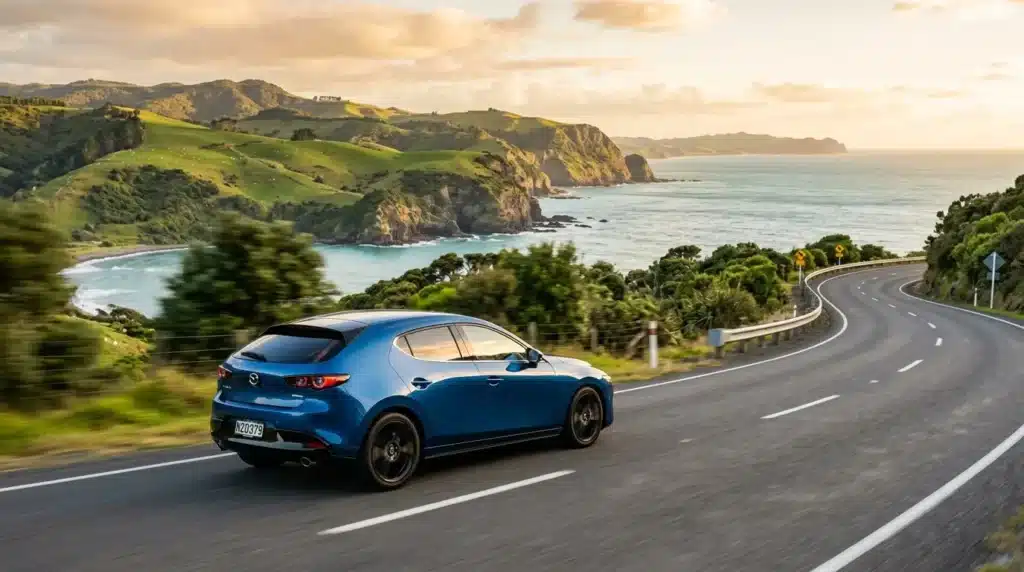
The Mazda 3 has a reputation in New Zealand that most cars never earn: people genuinely love it. Not just appreciate it — love it. And after spending time with the 2026 lineup, I understand why.
In a compact car segment full of competent-but-forgettable options, the Mazda 3 actually makes you want to drive it. The steering has feedback. The interior feels a step above what the price suggests. The build quality holds up in a way that matters when you’re buying used in five years.
But it’s not perfect for everyone. The small boot in the hatchback frustrates families. The base variant strips out features you might expect at this price point. And if you’re comparing pure value-per-dollar, the Toyota Corolla is a harder number to argue with.
Here’s my full breakdown — pricing, specs, variants, running costs, and who I’d actually recommend this car to in 2026.
Mazda 3 NZ 2026 Variants and Pricing: What You’re Actually Choosing Between
Mazda NZ offers the Mazda 3 in four variants, available in both hatchback and sedan body styles. The hatchback is the more popular choice in New Zealand — it suits urban driving and is easier to park — but the sedan gives you meaningfully more boot space if that’s a priority.
Indicative 2026 pricing (confirm with your dealer as prices are updated periodically):
| Variant | Body | Engine | Price (approx.) |
|---|---|---|---|
| G20 Pure | Hatchback / Sedan | 2.0L 115kW | $38,990 / $40,490 |
| G20 Active | Hatchback / Sedan | 2.0L 115kW | $42,990 / $44,490 |
| G25 Evolve | Hatchback / Sedan | 2.5L 139kW | $46,990 / $48,490 |
| G25 GT Plus | Hatchback / Sedan | 2.5L 139kW | $52,990 / $54,490 |
The G20 Pure is the entry point. You get the full Mazda i-Activsense safety suite — radar cruise control, automatic emergency braking, lane departure warning — which is genuinely good value. What you miss is the comfort extras: heated seats, the better audio system, and the quality interior touches that make the Mazda 3 feel premium.
The G20 Active adds 18-inch alloys, a heated steering wheel, heated front seats, and auto-folding mirrors. For most buyers, this is where the Mazda 3 starts to feel like the car it’s supposed to be.
The G25 Evolve steps up to the 2.5L engine and adds Bose premium audio, a head-up display, and leatherette seats. If you spend a lot of time driving, this is the variant where the Mazda 3 starts competing seriously with European alternatives.
The G25 GT Plus is the flagship: full leather, a 360-degree camera, a sunroof, and the complete Bose 12-speaker audio system. At $52,990 it’s a serious price for a compact car — but the in-car experience at this level genuinely surprised me.
Mazda 3 2026 NZ Variant Comparison
Prices are indicative for 2026 — confirm with your local Mazda dealer. Sedan adds approximately $1,500 to each variant.
How Does the Mazda 3 Drive on NZ Roads?
This is where the Mazda 3 pulls ahead of most of its competitors, and it’s worth being specific about why.
The steering is properly weighted — not artificially heavy, not numbingly light. You actually feel what the car is doing on the road. On NZ’s mix of motorway, regional highway, and winding back roads, this translates into a car that feels alive without being tiring. I drove it through the Remutakas and along Wellington’s coastal roads, and the Mazda 3 handled both with genuine confidence.
The G20 2.0L is more than adequate for NZ driving. It’s not the most powerful engine in this segment, but 115kW is enough for overtaking on open roads, and the 6-speed automatic doesn’t hunt for gears in the way some competitors’ CVTs do. It’s smooth, predictable, and economical.
The G25 2.5L adds meaningful pull — you notice it most when merging on motorways or driving loaded with passengers. If you regularly drive with four adults or tow a small trailer, the extra grunt is worth the premium. For solo city commuting, the G20 is genuinely enough.
Ride quality on NZ roads is well-balanced. The 18-inch wheels on higher variants do firm things up compared to the Pure’s 16-inch setup — something to consider if you’re doing a lot of distance on rougher provincial roads.
Interior Quality and Tech: Is It Worth the Premium Price?
The Mazda 3’s interior is the strongest argument for the car at this price point, and it’s where the comparison with the Corolla becomes genuinely uneven.
Mazda uses what they call Harmonics acoustic cabin technology — in plain English, it means the interior is quieter than most competitors at this price. At motorway speeds, road and wind noise are noticeably muted. Over a long drive, that makes a real difference to fatigue.
Materials quality is genuinely good. Hard plastics are minimal. The seats in the Active and above have a substantial feel that doesn’t deteriorate quickly — relevant for a NZ market where many buyers hold cars for five or more years.
The 8.8-inch infotainment display is controlled by a rotary dial rather than touch — which felt strange for about 10 minutes and then becomes preferable. You don’t leave fingerprints on the screen, and the haptic feedback of the dial is more precise when navigating menus. Apple CarPlay and Android Auto are standard across all variants.
The head-up display on Evolve and GT Plus is genuinely useful in NZ. Speed limit displays and navigation directions projected onto the windscreen mean less eye movement — worth having on unfamiliar regional roads.
One limitation: the back seat. The Mazda 3 hatchback’s roofline slopes sharply, and taller passengers in the rear will notice. For a family of four with teenagers, it’s manageable. For larger adults on longer trips, it can get uncomfortable.
Mazda 3 Safety in NZ: What Every Buyer Should Know
All 2026 Mazda 3 variants come with Mazda i-Activsense as standard — and this matters because some competitor brands still charge extra for the equivalent.
Standard safety across the range includes:
- Automatic Emergency Braking with pedestrian and cyclist detection
- Radar Cruise Control (maintains set distance from the car ahead — not just speed)
- Lane Departure Warning and Lane Keep Assist
- Driver Attention Alert (monitors for signs of fatigue)
- Blind Spot Monitoring from Active variant upward
- Rear Cross Traffic Alert from Active variant upward
The radar cruise control is the standout feature for NZ long-distance driving. On a Wellington-to-Hamilton or Auckland-to-Taupo drive, being able to set a following distance and let the car manage motorway speeds reduces fatigue significantly.
The Mazda 3 holds a 5-star ANCAP safety rating — the relevant benchmark for NZ — based on testing that covers adult occupant protection, child occupant protection, vulnerable road users, and safety assist systems. The result puts it in the top tier of the compact segment.
How Much Does a Mazda 3 Actually Cost to Own in NZ?
The purchase price is only the start. Here’s what you’re actually looking at for annual running costs in New Zealand:
| Cost Category | G20 (2.0L) | G25 (2.5L) |
|---|---|---|
| Fuel (15,000km/yr @ $2.55/L) | ~$2,600 | ~$2,975 |
| WOF | ~$75 | ~$75 |
| Registration | ~$130 | ~$130 |
| Service (annual) | ~$350–$500 | ~$350–$500 |
| Insurance (estimate) | ~$900–$1,500 | ~$900–$1,500 |
| Total annual | ~$4,055–$4,805 | ~$4,430–$5,180 |
Fuel economy figures in real-world NZ driving typically land around 7.0–7.5L/100km for the G20 and 7.5–8.0L/100km for the G25, depending on your driving mix. The official WLTP figures are lower, but I find real-world estimates more useful for budgeting.
Mazda’s service intervals are every 10,000km or 12 months. Parts availability in NZ is good — Mazda has strong dealer coverage nationally, and the aftermarket parts market is solid for a brand this size.
Use the calculator below to estimate your own annual fuel cost:
Mazda 3 Annual Fuel Cost Calculator (NZ)
Based on real-world fuel consumption estimates. Official WLTP figures will be lower.
Mazda 3 vs Toyota Corolla vs Honda Civic in NZ: How Does It Stack Up?
These three are the main contenders at this price point in 2026, and they each appeal to a different buyer.
Mazda 3 vs Toyota Corolla: The Corolla is more economical (around 5.7L/100km for the hybrid variant) and generally cheaper to insure and service. The Mazda 3 wins on driving feel, interior quality, and the sense that you’re driving something that was designed with care rather than optimised for cost. If you drive mostly city and want to minimise running costs, the Corolla hybrid is the better choice. If you care about how the car feels to drive and live with, the Mazda 3 edges it.
Mazda 3 vs Honda Civic: The current Civic has grown into a larger, more feature-rich car. It’s genuinely good — turbocharged, comfortable, with a strong tech package. The Civic is the better choice if you want more rear-seat space and a bigger boot. The Mazda 3 wins on refinement and that harder-to-quantify sense of quality in every interaction with the car.
Mazda 3 vs Volkswagen Golf: The Golf is the European benchmark in this segment. In NZ, the Golf tends to cost more to service and parts are pricier. The Mazda 3 undercuts it on running costs while getting genuinely close on interior quality. Unless you specifically want the Golf’s badge or its more extensive turbocharged engine range, the Mazda 3 represents better value in the NZ context.
Which Mazda 3 Variant Should You Buy in NZ?
My recommendation depends on how you use it:
Buy the G20 Active if you’re budget-conscious and want the full safety suite with the key comfort features (heated seats, proper alloys). It hits the sweet spot between price and liveability — you get 80% of the Mazda 3 experience at a price that makes sense for most buyers.
Buy the G25 Evolve if you regularly drive long distances or with passengers. The 2.5L engine makes motorway merging easier, and the Bose audio and head-up display are genuinely worthwhile over several years of ownership. This is the variant I’d personally choose.
Skip the GT Plus unless you specifically want the sunroof. At $52,990 you’re in genuinely strong competition from other brands, and the feature jump over the Evolve doesn’t justify the $6,000 premium for most buyers.
Choose the sedan if you regularly carry luggage or need to transport bulky items. The 444L boot is substantially more useful than the hatchback’s 295L. For city driving and daily commuting, the hatchback’s proportions are easier to manage in tight parking.
One thing I’d remind any buyer: check the driveaway price, not just the advertised price. On-road costs in NZ — registration, warrant of fitness, dealer delivery charges — can add $1,500–$2,500 to the sticker. Always ask for a total driveaway figure before comparing across brands.